Monday, 19 January 2015

Masons Arms, Hadfield

The Mason’s Arms in Hadfield near Glossop was a purpose built public house in 1853 by Timothy Holroyd’s Brewery.  The first landlord to take on the pub was Len Wadsworth at the relatively young age of 25; however, the first mention of him being a licensee in local directories was not until 1855. In the 1861 censes it states that Len had a wife called Hannah and had four children. Len Wadsworth stayed the licensee until 1891 he would have been 61.

Between 1896 and 1897 the pub was bought by several breweries until it was purchased by Moss Side Brewery and stayed so, until 1910 when the company went into liquidation.  The landlord at the time was John Nelson and is quoted in local archive newspapers to have said “these times are hard for us all, but we shall survive”.

The renewal of the licence was opposed in 1933, and was referred for compensation. The renewal was accepted after an appeal. A full licence was granted in 1956.  Then in 1964 Harry Dodd became licensee and it was not until 1972 when was given permission to by the shop next door and make into the lounge.

Unfortunately the Mason’s Arm’s has been taken over and been converted to a Tesco store. 

What do you think? Did you want it to remain a public house or do you want it to be a shop or another alternative community use?

What are your memories of the Mason’s Arms?

Royal Flying Corps


Royal Flying Corps

On April 13th 1912 King George V signed a royal warrant establishing the Royal Flying Corps. The early days of military flying became a reliable cost effective way of reconnaissance. Initially the Royal Flying Corps (FRC) consisted of a Military and a Naval Wing with the Military Wing that was made up of 133 officers, and by the end of that year it had 12 manned balloons and 36 aeroplanes.

The RFC's motto was Per ardua ad astra ("Through adversity to the stars"). This remains the motto of the Royal Air Force (RAF) and other Commonwealth air forces.

The RFC's first fatal crash was on 5 July 1912 near Stonehenge on Salisbury Plain. Killed were Captain Eustace B. Loraine and his observer, Staff Sergeant R.H.V. Wilson, flying from Larkhill Aerodrome. An order was issued after the crash stating "Flying will continue this evening as usual", thus beginning a tradition.
These vital preparations were worth the wait in gold when war broke in 1914. The Royal Flying Corps produced a country wide recruitment drive to entice 18 to 30 year old men to take to the skies. It is believed, that a member of the Howard family stepped forward in this early period. There are also some suggestions that this conscription push came to Glossop. There is a tiny piece hidden away in an article found in one of the local papers in 1914 adverting positions for The Royal Flying Corps.

Do you know anyone from Glossop who was involved with The Royal Flying Corps?

The pay was good, from two shillings a day for a Mechanic unto nine shillings a day for a Warrant Officer. The RFC were also responsible for the manning and operation of observation balloons on the Western front.
It was in 1918 when The Royal Flying Corps merged with the RAF witch still exists today. By the end of the Great War, the RFC had 3,300 aircraft with 5,182 pilots in service.

If you know someone who served with The Royal Flying Corps or documents of a recruitment drive in Glossop please get in touch.

By M. Cox

Check Out Our Events & Projects at glossoptours.moonfruit.com

Thursday, 15 January 2015

Over One Hundred Years of Benefit


In the year nineteen hundred and twelve the National Insurance Act was introduced which was, however, passed by the government the year before. This would see the first major benefits for not only the sick but the unemployed. The first stepping stones towards the National Health Service we have today.

The new National Insurance Act specified that every worker who earned under £160 a year had to insure themselves by paying 4 pence a week, the employer paid 3 pence a week, and the general taxation paid 2 pence. As a result, workers could take sick leave and be paid 10 shillings a week for the first 13 weeks and 5 shillings/week for the next 13 weeks. Workers also gained access to free treatment for tuberculosis and the sick were eligible for treatment by a panel doctor.

Unemployment had risen by 30% nationally the previous year but in Glossop there was a population just over 21,000 according to the 1911 census of which there was around 60 unemployed. The worker gave 2.5 pence/week when employed, the employer 2.5 pence, and the taxpayer 3 pence. After one week of unemployment, the worker would be eligible of receiving 7 shillings/week for up to 15 weeks in a year.

More than one hundred years on unemployment is at an all-time high Glossop’s current population is around 30,000 according to the latest census with over 900 unemployed, however, there is more than 6,000 retirees. 

By M.R Cox

Check Out Our Events & Projects at glossoptours.moonfruit.com


Icelandic Airline Crash 1951 - Crow Stones Edge on Howden Moors

Icelandic Airline Crash 1951

The Airspeed Consul TF-RPM of Icelandic Airline crashed 12th April 1951at Crow Stones Edge on Howden Moors.

The aircraft had begun life as an Oxford in 1942 and was used by the RAF and was used for training purposes. The aircraft manufacturer re-purchased the Oxford and converted it for civilian use by adding windows and passenger seats. The Consul was purchased by an Icelandic airline and was on its delivery flight from Croydon piloted by Pall Magnusson aged twenty six, and acting as the wireless operator was an Englishman, Alexander Watson aged forty two and a passenger another Icelander Johann Rist aged thirty five.

The Oxford before being converted to a passenger plane
It is thought that the pilot decided to fly visual rather than on instruments, despite a poor weather forecast and high wind speeds.

A lone walker, Ronald Yates of Sheffield discovered the wreckage and the bodies of the crew a few days later. They were probably killed instantly.


One of the engines at the site of the crash at  Crow Stones Edge on Howden Moors
Aviation Accident Investigation Branch found there was no mechanical fault with the aircraft and concluded that the aircraft had met the ground at full power. The investigation team believed the pilot got caught in the cloud and climbed to avoid high ground but with head winds of seventy miles an hour slowing his progress he must have miscalculated his position and when he descended through the cloud to establish visual, he flew straight into the ground.

A part of the crash site was excavated a few years ago which discovered the main frame of the aircraft along with one of the engines.

By M. Cox

Check Out Our Events & Projects at glossoptours.moonfruit.com

Thursday, 8 January 2015

Glossop Chimney - An Eyesore or Landmark? Erected by Ferro Alloys


The Chimney

The 250ft chimney was planned by Ferro Alloys in 1977 to be erected on Surrey Street, Glossop. Planning permission was sent and granted later that year despite a 5000 name petition that was sent to the government. There were several meetings set up discussing the proposed plans. By the end of the year there was some legal action against the build of the new chimney but no avail.

In 1978 the construction of the chimney began which ignited protests from local people and were reports of 3 men charged of actions against Ferro Alloys. There was an interview with High Peak Borough Council by an Ombudsman on the issues of Ferro Alloys chimney.  There was no action until 1983 when a new campaign was established against the notorious chimney. The campaign grew in force over the years and produced several protests. Then 3 years later in 1986 there was a public meeting about the subject which drew over 500 people. ‘Glossop Clean Air Campaign’ was launched all over the town attracted over 1000 people to join the fight against the chimney.

There were new regulations brought in that pressed Ferro Alloys but there was no sign of progress or closure of the site. Ferro Alloys remained on Surrey Street until 2004 when the site was vacated as it came into disrepair. There was some hope in 2009 for the chimney to be destroyed but it is still standing .

The surrounding buildings have now been demolished but the chimney standing approximately at 250ft still remains today. There are now plans to bring down the chimney with proposals to build new homes on the site. 

It still stands high above the town today and some people think it is an icon or and landmark others think it is an eyesore but what do you think?

By M.Cox

In Addition: Is it feasible to build new homes so close to the town centre on a road that has limited access? Should the site be used for community uses?

Monday, 14 May 2012

Glossop Street Parties


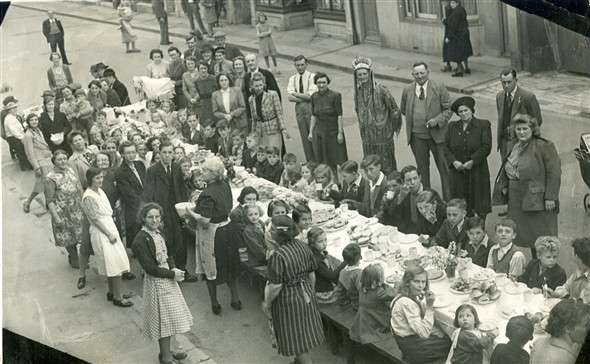
As the Queen’s Diamond Jubilee draws near people are preparing to celebrate. This year there is a whole variety of events to mark the occasion including the lighting of huge beacons right around the country. However, here in Glossop we have kept with the tradition of street parties. Surely no one can resist a party? A chance to have drink, relax and spend some time with friends and family.
The tradition of street parties as we now know as residential events that take place in their own streets seem to have taken off on a large scale in 1919. They were held in July as 'Peace Teas' as a genuine celebration of the signing of the Versailles peace treaty after the First World War. They were tea parties that were focused on a special treat for children in those times of hardship and were quite formal sit down affairs.


These residents led street parties were a popular mass participation and were probably a development of more formal public street dinners that had historically been held, such as for Queen Victoria's Diamond Jubilee in 1897. Then after the Second World War the entire county went street party mad. The craze continued with the coronation of Queen Elizabeth the Second. Street parties have been seen on many occasions since such as the Golden Jubilee and the Royal Wedding last year.

At the end of this month there will be small exhibition in the Glossop Railway Station depicting 60 years of Glossop past and present. There will also be a celebration walk on the 26th May and on the 9th June.

I am looking for photographs of Glossop street parties over the years. It would be great if we could find one from 1953 Coronation.

If you would like to share your photographs memories then please get in touch.

Monday, 7 May 2012

Masons Arms & Your Memories


Last week I asked for your thoughts and memories of the Masons Arms pub in Hadfield and the response has been overwhelming.

The Masons Arms public house has served the local community for over 150 years and has now closed with an uncertain future. There are already several plans in the pipeline from large chain supermarkets to convert the local pub into small a metro store.

I would like to thank everyone who has sent me a message over the last week as your memories and ideas have been pouring in. There are many happy memories, such as regular pub crawls that both started and ended at the Masons Arms. The pub held a “League of Gentlemen” convention in 2006 where people came from far and wide to celebrate the success of the hit TV show which was filmed in and around the town.

One memory that stood out was that of Bill Roberts:-

“One evening in early summer 1958 I walked down to the Masons Arms from the old farmhouse at the top of Hadfield Road which my wife and I had bought the year before. We had been married only a few weeks and just beginning to find our feet in the locality.
Serving my pint, the landlord asked if I would like to pay a few more pence for a chance on the domino tables. Much to my - and everybody else’s - surprise I got a seat. Many of the regulars had tried for years to get a place on the domino tables.

I did not know the finer points of the game, only that you had to put down a matching tile when you could. When the match ended I found that I had won and you can imagine how the regulars felt. They looked at me in astonishment mixed with suspicion - was I some sort of undercover maths genius come to torment them?”

There was a very clear message that no one really wants to see another supermarket open in the town, however, it is yet another one of our historic buildings that stands empty. A youth club, disco, café, music venue and a cinema are just a few of your ideas for a possible future for the 155 year old building.

What do you think should be done with the Mason Arm’s Building?


A special thanks to Bill, Jean & Allan


By Matthew Cox