Showing posts with label Old Glossop. Show all posts

Wednesday, 15 April 2020

Our History Is Being Rewritten | Glossop History


Our History is Being Written - But Do We Have a Chance to Shape It? 

I finally have an opportunity to sit a write through what can only be said as underrepresented times. I have been involved heavily with my other line of work which is assisting with end of life care and bereavement specialist. The world is changing and our social tendencies are changing forever. It might no be obvious from a closed door, or is it. the way we communicate strives of modern technologies, phones, iPads and computers. It is the way we react to other human being when we venture out, for those who seek their government guided walk or exercise. If you know your neighbor or the person you see the Glossop (Northern) way of greeting is an sincere hello and a smile. A resounding reassurance of our fellow neighbor has reignited the community spirit and is changing life forever.

We are reevaluating all aspects of life including, relationships, work, travel and most of all food. Many have taken the opportunity to use local produce, sellers and providers. I hope it will continue long after the storm but its not just that, its how we cook, the ingredients we use, how much and how we store them where the vast adjustments are being made. In the beginning of the outbreak people were hording or panic buying toilet rolls, hand wash and pasta. Along with tins and alcohol (where it was told it would kill the virus along with long lasting food, dried, tins and frozen. Some have gone back to having milk delivered along with bread and companies helping deliver hot meals and addition support to our most vulnerable. It its fantastic to see community groups strategically managing other organisations to help the most in need. The Bureau is doing just that, the headquarters of local operations. It sparks great reminisces of four local gents who I had the pleasure to work with who spoke proudly of being in the Home Guard in Glossop. I they let me document their stories and they were fantastic and I hope to transcribe them to share them with you soon. In addition I will be updating the website as I have been recording mini documentaries for you while you are staying safe at home at will be aired next week.

Some of the other stories they shared were of different training and preparation exercises, call outs and funny mishaps. They have shared some documents with me along with a small box of personal diary's which will take some reading as there is several of them. A document from the evacuation procedures in the town and a permit for a bike is among the items. Glossop was at the epicentre of both world wars because of its vast production power, range of equipment and techniques.

A part of history is repeating itself. The government announced within one of its daily televised updates for manufactures of all kinds to swap to making urgently needed supplies such as asking breweries for alcohol gel and others to make masks, face shields and ventilators. As part of one of my talks and guided tours I share the story of the admiralty walking through the large mills of Glossop and preparing just over 20 different war supplies. There is a fantastic picture in an archive in Cornwall (don't ask me how it got there) of just that. The powers that be stood for a very formal image of the secret war effort in Glossop. Join me on my mini documentaries to see more of this in more detail.

Now we do not hold the power of that but we do still hold the strongest of weapons, our community. So continue to do your bit and Stay at Home. This is our fight, the biggest fight of our generation. I will be continuing to care for our individuals and families that need support more than ever. It was pleasing to see carers from all walks of social care be recognised in tonight's briefing. To all my colleagues, clients, friends who risk their lives for the sake of others, take care and thank you for what you do so well.

On this day at the time of print 11.55pm Captain Tom Moore's 100th Birthday Walk for the NHS
He wanted to raise £1000 for the NHS for is 100th Birthday - Time of print 10.4 Million Great British Pounds had been donated, We as a family have contributed. Well Done Captain!


If you would like to see more see Website: glossoptours.co.uk
Mini Documentations and Tours from April 18th   Be Well Youtube Channel  https://tinyurl.com/u4zefol

Wednesday, 18 March 2020

A Moment in Time

Living In The Moment

We are all living in a unprecedented moment in time. We are living in a historic moment, where I hope we can pull together as a community, town, city or country.

Today marks the 55th anniversary of humans walking in space. 

We have shut down our main bread and butter of tours and public talks but this isn't stopping us from sharing our rich history along with improving our wellbeing, mental health and learning from behind closed doors.

We aim to achieve this in the coming days and weeks by voice, videos and posts that include, history, games, quizzes and lots of other possibilities.

We are going to look into the archives and share with you our findings of over a decade of research, discoveries and looking into private collections.

So share the links with family, friends  and loved ones. Read, comment and let us know your questions and what you might want to see next.

I never met any of my grandfathers but they have been my inspiration and fuel to do the things I do. One of I don’t talk much about simply because I don’t know much about him but in recent family chats it came to light that a hobby was to colour photographs in the 1960s. He would do them by hand with dyes and inks he would use them meticulously, precisely dropping ink to certain areas and bring a photograph to life. I will be sharing more of his hobby and him in general in a future post but its so easy to do them in an app or Photoshop these days but im going to have a go myself and have been playing around in a particular program to get an idea of  what I mean. You can see some of my efforts with this picture of the Old Cross, in Old Glossop around after 1912 marking the end of the original town centre, Howardtown became the new Glossop - Officially naming Old Glossop 'Old'.

I am looking forward to sharing my knowledge, findings as well as the mysteries and secrets our town has to offer.

Take care. Keep Safe and Speak Soon.

Don't forget to share with others, family and friends!

M.C

Monday, 24 July 2017

Glossop Tours Update 2017

Hello to readers old and new I thought it was about time to give you an update of what is happening with me and Glossop Tours and plans for the coming months. I have not forgotten you or about this blog.

I have not posted anything here for over 12 months and it has just gone so fast. I really don’t know where it has gone and so much has happened in the past year. In that time I have had over 20,000 more readers topping over 50,000 in all which is more than I have ever thought. This blog was the stepping stones of my epic journey and I will be posting again very soon.

Over the past 12 months so much has happened yet I still have not to come to terms of losing my main inspiration three years ago. I am only realising the vast about of respect, knowledge and understanding of local cultures, community and history I was taught for over 12 years.

September last year held new possibilities for me I was given a new job using my local knowledge and links to work with people with Dementia and Alzheimer’s with that is opened up the opportunity to do more with Glossop Tours. In February this year I had to have evasive surgery after funding lumps that were classified as suspicious cancerous tissue  that left me out of action for a couple of months.

In the last few months I was approached by a production group to take vlogs of the travels I have been doing to various places around the area and beyond. It proved rather successful and I am going to carry out another series as from the end of September but linking it in with Glossop tours.

In recent weeks I have been offered space in Glossop to have weekends and evening of events and to do history talks.

With everything moving on I haven’t had time to think yet I will be moving house in a few weeks and getting married next year.

Glossop has always been my first love and always will be and will be back sharing more interesting and intriguing stories about the town and local area.

There are new updates at glossoptours.co.uk

And I will see you all very soon, thank you for reading. Matthew Cox  

Wednesday, 20 July 2016

History Snippets of Glossop 1986

Here a series of historical snippets describing Glossop life in 1986.


Shirehill Hospital
Shirehill Hospital was opened in the 1800's as a workhouse. It is now a long stay hospital for the elderly. It does not have a casualty Department. There are 8 large rooms and a few rooms where equipment is stored. Four of the rooms are bedrooms and four are day rooms. The women's rooms are on the bottom floor and the men's rooms are upstairs. There are 60 beds in the hospital and all are filled. All the rooms are fully decorated and carpeted to make the patients feel more at home. The patients may do basket making, sewing, knitting, play dominoes or just sit and talk. In the summer the patients can sit out on the verandah. They say it is just like being at home.


The patients at Shirehill Hospital get their first drink at 6.30am. They can get up anytime between 8am and 10am. Breakfast is served at 9am. The patients are expected to get dressed when they get up. At 11am they have another cup of tea and biscuits. Dinner is served at 12 noon and afterwards they can go over to the day centre where they can make baskets or do other activities. On Mondays a lady comes from the library and the patients can loan books. If they feel tired then the patients can go to bed. Those who are bedridden have their own radio and there are televisions in all wards. At 5.30pm tea is served and after the patients may stay up until about 11pm.


The Commercial Inn
The Commercial Inn is a public house in Old Glossop. It is a typical pub which has a games room with a pool table and a darts board. The pool and darts team play other pubs on saturday nights. There is also a domino's team. Upstairs there is a room for hire. It has a small dance floor and a bar. This costs about £25 for one night. The most popular drink is handpumped bitter,which is kept downstairs in the cellar. The pub also sells food,ranging from pizzas to fish fingers and chips. They also do a special childrens menu.All these meals are eaten in the dining room. They also have lots of activities to do with music,for instance they have a disco,live music, and organ playing


Old Glossop Sub Post Office
Old Glossop post office is a sub post office on Manor Park Road. It sells stamps, National Savings Certificates, Premium Bonds,and you can use the National Savings Bank. You can also buy T.V., car and dog licences. The shop also sells gift tokens,sweets and cards. One person works there and he is expected to be efficient in handling money.Approximately 350 pensions and 290 family allowances are paid out each week. Some people travel from Chunal, Hadfield and Old Glossop to use the post office. Thursday is the busiest day because of the pensioners. The next nearest post office is on Victoria Street,Glossop. The Post Office is considering closing many small sub post offices like this one. Two in the Glossop area were closed in 1984.


Glossop Carnival
Glossop Carnival is held on the first Saturday in July. The procession leaves Hadfield School about 1.30pm and goes down Newshaw Lane, then along the A57 through Glossop and finally up Manor Park Road ending in Old Glossop. There are about 40 floats, 6 troops of dancers and 4 bands, including Glossop Band, Tintwistle Band and the Girls Brigade. Each local village sends their May Queen and individuals can enter in fancy dress. The fancy dress entries and the floats are judged by the Mayor of High Peak. A float is a car or lorry decorated specially for the occasion. This year floats included Alice in Wonderland, Fiddler on the Roof, and Victory in Europe Day. The winning float was the Rocky Horror Show. People throw money onto the floats and this is given to local charities.


Glossop Water Supply
Glossop's main water source is the reservoirs. The reservoirs were built in this area because of the high rainfall of over 1,000 mm per year and the impermeable rock. There are two reservoirs, one called Hurst opened in 1961 and one called Swineshaw opened in 1972. Hurst Reservoir has an area of 13.5 acres and a capacity of 36,500,000 gallons. The depth of the water is 25 feet, and it is 588 feet above sea level.Hurst's treated water output is 1.749 mega-litres per day. Swineshaw Reservoir has an area of 21 acres, and a capacity of 56,300,000 gallons. The depth of the water is 34 feet,and it is 558.6 feet above sea level. It's output is 3.04 mega-litres per day.This area is part of the North West Water Authority.


Industry in Old Glossop
Union Carbide is an industrial plant which is located in Old Glossop . Forty one people are employed,most of these are men.The average age of the workers is roughly fifty years old, but the office staff are much younger. The present plant was opened in 1950 and is one of the most modern in Europe.The workers in the warehouse (the main building) all wear protective clothing. Union Carbide produces briquettes of different kinds. This is the only Union Carbide plant in England to make these. To make the briquettes chromium, silicon and manganese are needed. These raw materials are imported from Zimbabwe and Canada.

These and more can be found on various websites. Many have been collated on the reloaded Doomsday Book on the BBC.

http://www.bbc.co.uk/history/domesday/dblock/GB-404000-393000/page/1

Complied By Matthew Cox

Tuesday, 19 April 2016

Glossop 1912

We are continuing into 1912....

At the heart of some of the world’s most devastating events, shocking incidents and even the greatest achievements, are the people from Glossop in the year of 1912. Over the coming weeks I will reveal a whole host of staggering facts, stories, eyewitness accounts, and sporting achievements that took place over one hundred years ago.


I would like to first turn to one of the oldest parts of the original village of Glossop. The stone shaft that makes up the main frame of the Old Cross has stood the test of time. It thought to have been placed here around 1157 when the parish of Glossop was granted to hold a court, a fair and a market around the stone cross. Over the centuries it became custom to announce the new kings and queens and other important messages from the cross, after all it was the centre of the town. It was not until the early 1800s when the cotton industry began to develop further down the river when plans were put in place to pursue a new town centre. It was when the new complex at Howardtown was built in 1838 when things really began to change. Over the next few years it was clear the offices and court room along with the fast development of the new cotton mills, Howardtown, by far superseded the original part of the town. Glossop was granted a borough in 1866 and people began to regard Howardtown as the centre of Glossop.

In 1910 it was moved to where it stands today
The Old Cross never bore the Celtic stone cap to begin with. 1910 saw the reign of George V which was announced at the cross like the many Monarchs before him. The officials of the Borough of Glossop wanted to place a cap on the stone cross not only to mark the coronation of the king but to symbolise the unity of faiths. The cross was moved from its previous position as it was tight against the house behind, to where it stands today. The Celtic cross was finally placed on top of the ancient cross in 1912.


The Old Cross in Old Glossop

Monday, 14 March 2016

Olympic Games 2016 - Throwback Football Heroes 1912


Throwback Football Heroes 1912

The country is making final preparations for one of the greatest sporting events, the Olympic Games.  As the last adjustments are being made in Brazil, however, preparations around the country are taking place in order to select the British Olympic Team.

One hundred and four years ago the Olympic Games in 1912 were to be held in Stockholm and in April that year the British Team were to be selected. At that time the sportsmen who were selected were mostly amateur and unpaid, never the less they were the very best of their field.

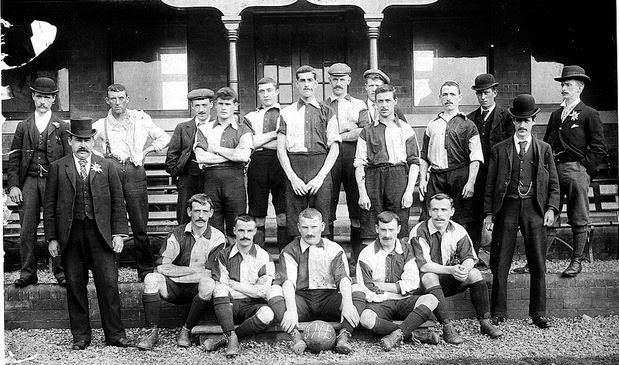
Glossop has always been highly active in sport over the years and 1912 was no different. April 8th saw Glossop FC (formally Glossop North End) grab a vital point against Grimsby Town as Glossop battled against relegation in the Second Division.

Towards the end of the season, two men attend a match at North Road to observe the team. It is believed they were “tipped off” maybe by a current or ex player of Glossop that the team had obtained some “legend” players. Olympic records show that one of the men was Terry Graham, a man who worked for the British Olympic team as a sort of scout.  No one knows for sure but it is likely that the “tip off” came from Samuel Hill-Wood himself as he still owned the club although he was no longer manager. He was in London most of the time, as he was standing for MP for the High Peak.

By the end of the season Glossop FC just managed to scrape out of the relegation zone by goal difference. Immediately after the season had finish the British Olympic Football Team was announced and on the team sheet were players from Glossop Football Club.  Stockholm 1912 saw many great achievements let’s hope Team GB can do the same this year.

 By Matthew Cox

To Be Continued…

Monday, 23 March 2015

Glossop North End AFC - Samuel Hill-Wood

The Legends of Football - Part One - Lost Heroes, Treasured Pride by Matthew Cox

Sir Samuel Hill-Wood, born on 21 March 1872 the son of Samuel Wood and Anne Kershaw Sidebottom, lived a long and prosperous, public life.

From early childhood Samuel Hill-Wood known locally as “Sammy” showed an unbelievable understanding of his family’s cotton business and how it was constructed and managed. Inspired by his father and grandfather to continue the business he was sent to be educated at Eton College. It was here where Sammy first acquired his obsession with sport. On returning from College, Sammy was fascinated to hear that Glossop had set up their own football club (Glossop North End) and that some of his father’s employees were involved. In response he organised a team representing his fathers company named Howardtown F.C. He played alongside employees in local leagues which consisted of teams from butchers, victuallers and rival mills. As the football game grew nationally, Howardtown F.C was not enough for Sammy and he began talks with other clubs. It was around this time rumours began saying that Samuel Hill Wood wanted to “buy” a football club.

Sir Samuel Hill-Wood in 1928
In April 1888 his father, Samuel Wood died aged 69; with this Sammy inherited his fathers business at Howardtown mills, life savings and reputation. This gave him the incentive to carry out his ambition to create a high class football club. Sammy delivered his proposal to the founders of Glossop North End and it was accepted almost immediately. He hand selected a small team of men that consisted of a secretary, two trainers and a scout.  This “Scout” travelled the land observing the top teams of the time such as Manchester City and Preston North End for the perfect players. Sammy expressed in a telegram that, “money is the key “; a quote that still applies today. Sammy also pulled some strings in his cricket line of work, persuading fellow cricketers to come and play for him. By 1890 Glossop North End were playing in the North Cheshire League and things were looking good.

In the early 1800s the game of football was used as tool to encourage young men to go to church and to maintain a “team” spirit on the day of rest. However by the late 1800s the sport had developed not only into a national game but an entertaining enterprise. Samuel Hill Wood had spotted not only an opportunity for investment, but also advertisement on a national scale. When Sammy turned 22 he injected a huge sum of money into the club, big enough in fact to start paying wages and turned the club professional. 

This same year also saw Sammy make his debut in cricket playing for the Derbyshire County first team.  Glossop North End were making national headlines when they entered the Second Division of the Football league.

Sammy loved the attention he and the club were getting so much so he boosted the club yet again with another financial push. 

This gave them the edge they needed drafting in some of the best players from teams from all over the land and even overseas. Building in confidence the team began to draw in huge crowds which brought the money rolling in. This could be seen when Glossop North End played local rivals Manchester City at North Road. Just over 7,000 were in attendance to see City win in a narrow victory over Glossop of 2-1. From this one match they had taken £150.18s.4d on the turnstiles alone
Glossop North End - The team who won promotion in 1899
.
There was a huge uproar not just nationally but worldwide when Glossop North End made it into top flight football. In 1899 the nation stared in disbelief that a small town deep within the hills were battling it out on the pitch with some of the nation’s top teams from some of the wealthy cities. This could not have been possible without Samuel Hill Woods astounding insight, a true pioneer of sport. Sammy continued to work closely with the club even taking them to a F.A Cup Quarter Final in 1909.

In 1910 Sammy began a new career as a conservative MP for the High Peak. In 1913 he was involved in top secret government plans and had an early insight of what would unfold to be the Great War. So with that in hand he returned to Glossop and began to sell his shares in the club. But the influences of Sammy remained in Glossop as the "Hillmen” or “Wood’s Men” began their battle in the F.A Cup 1913. Even with Sammy gone from the club, the reputation remained as a record of 10,736 people flocked to see Preston North End at North Road for the F.A Cup 2nd Round game.

Throughout the years to this day the legend of Sir Samuel Hill-Wood remains. As we celebrate entering the Final at Wembley of the FA Vase, the “Hillsmen” are a distinct reminder of that great pioneer. Just think Sammy had his own football club at the age of 18 and in the space of 14 years his club, Glossop was and still is to this day the smallest town in England ever to have a team grace the top flight football league.

By Matthew Cox 

Follow me on Twitter: @Matthew_R_Cox    or    @ GlossopTours  for more updates about this historic club.


Tuesday, 10 March 2015

History of Glossop's Paths & Roads - Grab Alley

History of Glossop's Paths & Roads 

Part One - Grab Alley

There are many alleys and hidden roads in Glossop that people forget about these days, unless you are a Glossopian.  You will find that many of these alleys are public footpaths and can prove a great asset in order to get you from A to B in a very short amount of time.


One notorious Glossop alley is barely visible today yet many people use it without realising it. There is very little left of the original walkway which has now been replaced with a pedestrian crossing on the car park of Tesco in Glossop. The original walkway ran the full course of the new crossings today from the river on High Street West up towards the supermarket entrance.

The original path connected the lower part of High Street West, up towards North Road for easy access from the Wrens Nest Mills. It also connected with paths to Glossop, Whitfield & Simmondley used mostly by employees to and from home. The pathway was continuously used down the years as it became a handy access to the football at North Road and cricket matches which were played there. It was also a great link between The Hanging Gate Pub (now demolished) and the new Glossop North End football ground on Surrey Street when they moved in 1955.

This walkway was nicked named “Grab Alley” as young ladies who used this footpath were at risk of being “grabbed” by the young men of the town. It was also known for pickpockets to work this part of town.  The path was enclosed by a high wall either side that was topped with triangular capping stones. The original iron bridge matched the height of the wall but was badly damaged by the Whit Monday floods in 1944.  The house which stood next to the footpath, collapsed due to the damage by the flood.  The woman who lived in the house went to look at the damage from the bridge but it gave way into the water and she was swept away by the strong current. Her body was found in the River Etherow at Compstall the following day.


Today the same walkway is used by hundreds of people everyday as it is part of the Tesco Stores part of the pedestrian crossings but to many locals it will always be known as Grab Alley.

By Matthew Cox 

www.glossoptours.co.uk

Monday, 23 February 2015

Day Trip to Glossop? - Glossop Advertiser 1912

Day Trip to Glossop For a Sixpence

The summer is now not to far away, however, day trippers continuously pour into our town throughout the year. Things have not changed for well over a century because last summer I found a column in the Glossop Advertiser back in 1912, by a local columnist expressing his feelings about day trippers who came from Manchester to Glossop for a sixpence.  


"The summer season is now in full swing, that especially as regards the running into Glossop of cheap excursion trains on Sundays is concerned, a note of warning should be thrown out to certain visitors of both sexes who come into this pleasant Derbyshire town. Let it be clearly understood that there is not the slightest desire to put forth any argument against the introduction into Glossop of trippers. But we echo the public feeling that those cheap excursionists should behave themselves and that failing to do so the law should step in and administer a lesson not readily forgotten. It seems to have occurred to the minds of say Mancunian visitors that they are at liberty to turn Glossop into a bear garden and we are bound to say that the local justices have not as a rule made ‘the punishment fit the crime’.


It is true that, as the greatest of England’s poets says, “The quality of mercy is not strained”. That is the rule, but to most rules there are exceptions and we are inclined to believe that with regard to Sunday delinquents brought before the Glossop Police Court the merciful quality has distinctly been strained. There is a considerable proportion of these sixpenny trippers that can fairly and honestly be designated a nuisance. If people wish to escape on the Sunday from Manchester or elsewhere to healthful Glossop we admire their decision, but having arrived in the town, having availed themselves of the privilege of cheap access thereto, having left a smoke-begrimed city for the delights which Nature affords, the least they can do is to conduct themselves with propriety. But many of them do not, and they should be taught to recognise the force of the law.

Damaging grass lands, breaking trees, card playing, footballing in the public streets, and so on, are items of objectionable amusement that have been practised by a certain class of visiting hooligans, whose absence would be far preferable to their company. We want to see established by the magistracy the preservation of Glossop’s good name, and therefore we hope that stringent penalties will be in future imposed upon all offenders. Readers who revert to the report in other columns of this issue of the ‘Advertiser’ of the proceedings in the Glossop Police Court will see that the local Justices have made up their minds to stand no further nonsense. Their decision is quite right and proper, and we commend them for having arrived at it. The police have done, and are doing, their level best to stamp out the illegal and unwarrantable doings of the class of persons to whom we have so pointedly alluded. It has been pretty well accepted as a truism that there is a black sheep in every flock. Biblical instruction shows the vast difference and distinction between the sheep and the goats. In Glossop the sheep from Manchester are always sure of a cordial welcome, the goats – well, may either stay at home, or be sure either of being substantially fined or relegated to one of His Majesty’s hotels, which are usually designated by another expression."


Have things changed?


Complied by Matthew Cox

Thursday, 29 January 2015

A History of Glossop Railway Line & Beyond...

A History of Glossop, Manchester & The Woodhead Railway Line


Part 2 of 6 - Glossop -"The Link to Foreign Lands"

The Glossop branch was built by the 13th Duke of Norfolk when the historic Manchester to Sheffield line bypassed the town in 1845. The Duke gave his land and paid all the expenses for the one mile extension from Dinting Vale to Glossop. The initial station was complete with a private waiting room with a fire place and a small room for the station master, porters and other staff. Glossop station was initially for the sole use of the Duke of Norfolk when he resided during the summer months at his manor house, Glossop Hall. 


Glossop Central opened for goods traffic on 9th June passenger traffic began on 30th June 1845.

Glossop station provided a direct link to the outside world, as there was only one stage coach that ventured out of the town a week to Manchester and Sheffield before the railway was built. The Duke welcomed new shipments of coal, slate & wood. He saw the potential for growth and commissioned a goods depot and yard adjacent to Glossop Central in 1847. The goods yard was complete with the Lord Howards Lion, which still stands to this day, a reminder the Duke freely gave his land and money.

The railway was responsible for the rapid growth of the town, throughout the late 1800s. Over 50 mills scattered the valley dependant on a variety of shipments such as cotton from America and timber from Scandinavia.  The Duke of Norfolk sold the line and gained double profit to what would become the Great Central Railway.

The station was renamed on 10th July 1922 as Glossop Central.

Glossop Central expanded the passenger section of the station opening a booking office in 1847 and a waiting room for the 1st and 2nd Classes. The station also had refurbishments in 1912 when the iron stanchions were put up that still exist today. As the town began to thrive a second passenger platform was built.

The railway transported local troops during the two world wars which proved to be a great asset as some of the Glossop men were in the first wave of the Dunkirk landings. They also brought evacuees from Lowestoft to safety in Glossop

During the early 1940’s Glossop, along with the rest of the Manchester and Sheffield via Woodhead line, were making preparations for electrification but was halted due to the 2nd World War.  The line was the first all-electric line in Britain with the first electric train arriving in 1954. The station was refurbished to meet the needs of the new trains but resulted in the closer of the waiting rooms.

In the 1980s the goods yard was closed then in 1982  the second platform closed.

In 2002 Friends of Glossop Station (FOGS) were set up and set upon saving and preserving the historic station. They were responsible for new improvements including new skylights reopening and renovation of the waiting rooms and a new booking office in 2011. 

Monday, 14 May 2012

Glossop Street Parties


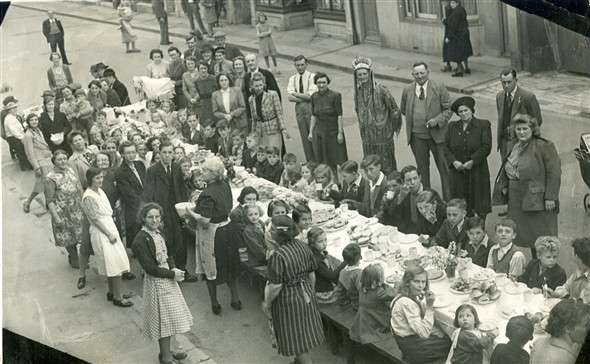
As the Queen’s Diamond Jubilee draws near people are preparing to celebrate. This year there is a whole variety of events to mark the occasion including the lighting of huge beacons right around the country. However, here in Glossop we have kept with the tradition of street parties. Surely no one can resist a party? A chance to have drink, relax and spend some time with friends and family.
The tradition of street parties as we now know as residential events that take place in their own streets seem to have taken off on a large scale in 1919. They were held in July as 'Peace Teas' as a genuine celebration of the signing of the Versailles peace treaty after the First World War. They were tea parties that were focused on a special treat for children in those times of hardship and were quite formal sit down affairs.


These residents led street parties were a popular mass participation and were probably a development of more formal public street dinners that had historically been held, such as for Queen Victoria's Diamond Jubilee in 1897. Then after the Second World War the entire county went street party mad. The craze continued with the coronation of Queen Elizabeth the Second. Street parties have been seen on many occasions since such as the Golden Jubilee and the Royal Wedding last year.

At the end of this month there will be small exhibition in the Glossop Railway Station depicting 60 years of Glossop past and present. There will also be a celebration walk on the 26th May and on the 9th June.

I am looking for photographs of Glossop street parties over the years. It would be great if we could find one from 1953 Coronation.

If you would like to share your photographs memories then please get in touch.