Showing posts with label Heritage. Show all posts

Thursday, 23 June 2016

Will Your Vote Change the Country and Glossop?

Do people realise just how important this vote is?

Personally I don't think there has been any true leader during the latest campaigns. The fights between the leaders have all been seen by us all but why don't they fight like that each and every day in our own and european parliaments? We might of never needed this referendum in the first place.

Why have a referendum? Was there concern about our european status in the first place?

I don't know what the verdict will be but I just hope it gives a boot up the government to show, we the people really do care, hear and work for our country and yes we do have a voice. I hope everyones voice is heard come the result. That would be one of the best things to come of this.

Enough with the politics....
Will it change the Glossop landscape?

Yes. Still holding a very deep breath for the chimney to come down, work should of started this month. I don't think there will be a bypass any time soon... Plans have been in the works for 80 plus years so why would they start now?


Do you think Glossop will change and develop for the better?

The History of the Chimney

Hidden Gems of Glossop

Figureheads of Glossop

Tuesday, 2 February 2016

Glossop Connections - Charles Calvert, Raisley Calvert & William Wordsworth

Glossop Famous Connections
The Calvert Family - A Celebrated Artist. Charles Calvert Junior.

In my last post I had mentioned that Charles's first son, was Frederick Baltimore Calvert but it is in fact it was his second. I have managed to trace that Charles had in fact eight children. His first child was also born at Glossop Hall and was named after his father on 23rd September 1785. Records show that Charles Calvert Junior was taught at the hall itself in Glossop, Derbyshire. He became an apprentice to his father within the family cotton business. He seems to become a very successful cotton merchant until, however, he abandoned cotton for art and became a landscape painter.

His influences for this drastic change of mind came from his uncle, Raisley Calvert who was a renowned sculptor. Raisley Calvert, was in fact, the Steward to the Duke of Norfolk, and looked after his estates at Greystoke. Raisley not only had a great career but great connections as he was a close friend and admirer of William Wordsworth. They were at Cambridge University together where they became very good friends, this is their story...

William & Raisley 
William Wordsworth
William was sent to school at Hawkshead where he made friends with a boy from Cockermouth called William Wordsworth. The two boys were the same age and from similar backgrounds. Wordsworth’s father was an agent for Sir John Lowther, the Earl of Lonsdale. When they left school Wordsworth went to Cambridge, travelled abroad and lived for a while in London while William joine
d the Duke of Norfolk’s Regiment (then known as the 12th Regiment of Foot) of the Militia. In 1791 William’s father died, and he and Raisley inherited a sizeable fortune.
In July 1793 William Calvert invited Wordsworth to accompany him on a tour of the West Country, all expenses paid. Wordsworth wanted to become a poet but had no job and no income. He eagerly accepted William’s offer and the two young men set off. They spent about a month on the Isle of Wight where they watched the English fleet preparing for the war with France. They then headed west, but near Salisbury their horse dragged the carriage in which they were travelling into a ditch and it broke into pieces. The two men decided to separate. William took the horse and rode home to Keswick while Wordsworth set off on foot and walked across Salisbury Plain. He travelled through very bad weather, rested at Stonehenge and had some visions: an experience which led to the writing of his poem ‘Salisbury Plain’. Later that year he visited William and his brother Raisley at their family farm at Windy Brow on the slopes of Latrigg near Keswick. 
In early April of the following year William invited Wordsworth and his sister, Dorothy, to stay at Windy Brow. Wordsworth and Dorothy were delighted. They had been separated since childhood. After the death of their mother in 1778 Dorothy had been sent away to live with relatives. They had met up again in Halifax for six weeks but now they looked forward to a holiday together. They travelled by coach to Kendal then walked the eighteen miles to Grasmere and a further fifteen miles to Keswick. William Calvert was away with his regiment but Wordsworth and Dorothy stayed with his tenants at the Windy Brow farmhouse (Right). Dorothy loved staying at Windy Brow. She wrote to her friend, Jane Pollard, saying how delighted she was with the situation of the house.
She described, in glowing terms, the view from her window which looked out over the River Greta, Keswick town and Derwent water. She described how cheaply she and her brother could live, with milk for breakfast and supper and mainly potatoes for dinner. There was a terrace path on the slopes of Latrigg, above the house, where Dorothy enjoyed walking and admiring the view of the vale of Keswick . They spent a month at Windy Brow and it was during this time that Dorothy first started to copy out Wordsworth’s poems: a job which she would continue to do for the rest of her active life. 
Later in 1794 Wordsworth returned to Windy Brow to find that William’s brother, Raisley, was very ill with consumption. William was with his regiment in Tynemouth, Northumberland. Wordsworth suggested that he might accompany Raisley on a visit to Portugal to improve his health if William would cover the costs. At the same time Raisley decided to write a will. He left everything to his brother except for a £600 legacy (later increased to £900) to Wordsworth. Wordsworth wrote to William asking for money for the trip to Portugal. William responded immediately and offered to pay all costs. Wordsworth and Raisley set off but they only got as far as Penrith and had to turn back the next day because Raisley was worse. Wordsworth stayed to nurse Raisley at Windy Brow but Raisley died in January 1795. Raisley’s legacy was a valuable asset for Wordsworth at this time.

There are records to show the visited family and went to a "hunting lodge" which is strong evidence that they visited Glossop at this time. During the early periods of Glossop Hall it was used as a holiday home and a hunting lodge. it is just wonderful to think that this great man made his presents in Glossop itself.

This friendship was so strong that William Wordsworth visited Raisley on his deathbed and personally cared for him right up until his death in 1794. Unknown to William, Raisley had left him a legacy of nine hundred pounds, a small fortune of the day, as a mark of gratitude. William never forgot this as he wrote later:

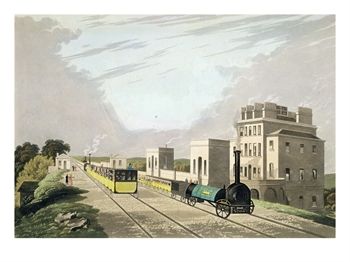
 Manchester and Liverpool Railway in 1825 by Charles Calvert


"Calvert! It must not be unheard by them
Who may respect my name, that I to thee
Owed many years of early liberty.
This care was thine when sickness did condemn
Thy youth to hopeless wasting, root and stem."


Charles Calvert Junior became a great landscape painter and teacher of art. One of his most famous paintings was of the Manchester and Liverpool Railway in 1825. He was one of the founders of the Manchester Royal Institution now the Manchester City Art Gallery. He gained the Heywood gold medal for a landscape in oil, and the Heywood silver medal for a landscape in watercolour. He loved to spend his spare time in the Lake District. When he died he was buried at Bowness-on-Windermere.

Compiled By Matthew Cox

In Addition:

William Wordsworth died in 1850. A few years later the Greta Bank estate was sold to Mr Anthony Spedding. The house at Greta Bank was substantially rebuilt and has now been converted into apartments known as ‘Brundholme Country Houses’. Calvert’s Bridge has given its name to the nearby ‘Keswick Bridge’ Timeshare Lodges. In 1978 John Fryer Spedding set up the Calvert Trust to provide outdoor adventure activities for people with disabilities. The name was chosen in memory of Wordsworth’s benefactor, Raisley Calvert, ‘to represent friendship, support and the desire to help somebody to fulfill their potential’. The Windy Brow Farm where Wordsworth nursed Raisley is now owned by the Trust. Calvert was an interesting character. He had some influence on the Lake Poets, he took a keen interest in agricultural development and he was a kind and generous friend to those around him.

More Information & Sources

Calvert, Charles (1785–1852), landscape painter, born at Glossop Hall, Derbyshire, on 23 September 1785, was the eldest son of Charles Calvert (1754–1797), land agent, and his wife, Elizabeth Holliday (1751/2–1842). His father was agent of the duke of Norfolk's estate in Derbyshire and an amateur artist. Charles Calvert senior died on 13 June 1797 and was buried in St Mary's churchyard, Manchester. Calvert began business as a cotton merchant in Manchester, having been apprenticed to the cotton trade, but abandoned commerce for art and became a landscape painter. He was instrumental in the foundation of the Manchester Royal Institution (which later became Manchester City Art Gallery) and gained the Heywood gold medal (awarded to local artists) for a landscape in oil, and the Heywood silver medal for a landscape in watercolour. The Manchester Courier reported in 1828 that, of local artists, Calvert's paintings were the most consistently sold. He was not well known outside his region, however, and exhibited only two works in London, one of which, at the British Institution in 1825, was entitled Near Rustom, Cheshire.

Calvert devoted much of his time to teaching, and spent the remainder painting in the Lake District. Although confined to his bed in later years, he continued to paint landscapes from memory. He died at Bowness, Westmorland, on 26 February 1852, and was buried there. Examples of his work are in the Victoria and Albert Museum, London, and Manchester City Galleries.

Charles Calvert's brothers included , actor and lecturer on elocution, , surgeon, Henry Calvert (1785–c.1869), sporting and animal painter, and Michael Pease Calvert, painter. He was father-in-law to the portrait painter .

In the Dictionary of National Biography Raisley Calvert (bap. 1773, d. 1795), friend and benefactor of William Wordsworth, is incorrectly described as Charles Calvert's younger brother. Raisley Calvert was baptized on 16 September 1773, the younger son of Raisley Calvert senior (1728/9–1791), steward of the duke of Norfolk's estate at Greystoke Castle, near Penrith, Cumberland. His elder brother was William Calvert (1771–1829), who was at school with Wordsworth at Hawkshead, Lancashire, where he later became schoolmaster. On the death of his father, William Calvert became a man of independent means, inheriting, with other property, the estate of Bowness on the east shore of Bassenthwaite, near Keswick. Raisley Calvert inherited from his father several farms near Keswick, the income from which was held in trust until he attained his majority in 1794. He was admitted to Magdalene College, Cambridge, on 14 February 1793, where he became friends with Wordsworth, but left soon afterwards with a resolve to educate himself by travel on the continent. Though described in the Dictionary of National Biography as a sculptor, no evidence has come to light of any works sculpted by Raisley Calvert. On falling ill with consumption, he returned to the Lake District, where he died at Penrith after 7 January 1795, when Dorothy Wordsworth mentioned that he was ‘barely alive’ (Letters of William and Dorothy Wordsworth, 139). He was buried on 12 January. In his will, signed on 23 October 1794, Raisley Calvert left £900 to Wordsworth. The poet subsequently wrote a sonnet, ‘To the Memory of Raisley Calvert’, and later mentioned him in lines 349–67 of the thirteenth book of The Prelude:
A Youth (he bore
The name of Calvert.
(lines 349–50)


Sources  

W. E. A. Axon, rev. L. R. Houliston, Art Journal, 14 (1852), 150 · S. Urbans, GM, 2nd ser., 37 (1852), 630 · T. Fawcett, The rise of English provincial art: artist, patron and institution outside London, 1800–1830 (1974) · G. Meissner, ed., Allgemeines Künstlerlexikon: die bildenden Künstler aller Zeiten und Völker, [new edn, 34 vols.] (Leipzig and Munich, 1983–) · M. Hall, The artists of Cumbria (1979) · D. Child, Painters in the northern counties of England and Wales (1994) · Bryan, Painters (1903–5) · Redgrave, Artists · Mallalieu,Watercolour artists · M. H. Grant, A chronological history of the old English landscape painters, rev. edn, 8 vols. (1957–61) · IGI · H. M. Cundall, A history of British water colour painting (1908), 193 · The letters of William and Dorothy Wordsworth, ed. E. De Selincourt, 2nd edn, rev. C. L. Shaver, M. Moorman, and A. G. Hill, 8 vols. (1967–93), vol. 2, pp. 81, 97, 126n., 139–40 · W. Wordsworth, Poems, in two volumes, and other poems, 1800–1807, ed. J. Curtis (1983), 151–2

Sunday, 6 December 2015

Woolworth's at Glossop 1941 to 2009


Winter Woollies

“It’s beginning to look a lot like Christmas”. There is definitely a chill in the air as the festive season sneaks in to town.  There was a feast of traditional sights and smells that were sampled by many at the Glossop Christmas switch on, last Saturday evening. The celebration kick started the late night shopping throughout the town and market, for all your gifts, goodies and treats.  It was at that moment I reflected about our more recent history.

In 1941 the drapers at 9 High Street West was bought by the American company that was spreading the country by storm. That company was F. W. Woolworths. It opened its doors later that year and offered a wide range of wares. It was to become one of Glossop’s first self-service stores. Previously you would have given your shopping list to the shopkeeper in order for them to find the goods for you.
The first Woolworths store to open in America was back in 1879 then in 1909 the first British store opened in Liverpool with a huge celebration with a full orchestra, circus and firework display. It was then in 1910 that Frank Woolworth commissioned the design and construction of the famous Woolworth building in New York.
Back in Glossop the store was vital throughout the war years, providing a wide variety of goods that were available all in one place.  It was an early example of the modern supermarket. The store expanded over the years taking up three shop spaces. The original sign over the door read “Woolworths. F. W Bazaar” and was set in gold and black very similar to the Finlay McKinlay’s sign next door.  The name changed over the years as it became a British company. This resulted in the famous red sign we all knew and loved.
Woolworth's lasted 68 years in Glossop as it closed its doors in 2009. During its closing down sales it sold everything right down to the fixtures and fittings.
Woolworth's was a local favourite and a national icon but will you miss it this Christmas?

By Matthew Cox

Wednesday, 16 September 2015

Glossop Cotton Queens - From Miss Glossop to Miss England 1930


The Cotton Queens 


According to a recent survey over 18 million people attend music festivals here in the UK every year. Music, arts and film festivals are on the rise and now attracting global attention bringing in the biggest names. History festivals are now starting to crop up here and over thirty took place over the summer.

There have always been festivals in Glossop some festivals have survived the test of time and some have now faded. It was not up until recently that we celebrated the May Cotton Queens. This festival celebrated just one thing, cotton. This one day in May was dedicated to a huge, colourful parade throughout the town. It was not only to celebrate the towns industry but an advertisement! A huge competition would take place between all the mills in the valley to determine the best cotton queen. The mill owners would choose the fairest girl within their business to showcase their finest product, similar to the Miss World competitions today.

They would parade through the town on the back of rickshaws and flatbeds and later vans. Some would depict a moment in history and others would show fashion, similar to the floats we have today at carnivals. It would then be up to a panel of judges normally including the Mayor to announce and crown “Miss Glossop”.

Then later in June it would go National a massive competition to find the “Cotton Queen of England”. I have found a report in a 1930s National newspaper, a truly fascinating little piece of our history, how “Miss Glossop” got to the final.

Cotton Queen 1930 Miss Glossop to Miss England  


In May 1930 Cotton Queen Festivals took place all over the North West of the country. Glossop held one of the largest; over 60 queens were presented that year from far and wide. The competition was fierce; competitors came from Manchester, Hyde and Cheshire. The competition was won by Miss F. Lockett who came from Newton Moor Mills of Hyde, a weaver aged 20. Miss Lockett was crowned ‘Miss Glossop’ and was paraded through town and was done so with,  “full of delight and splendor” according to a local reporter.

In June following on from the regional events, the Nationals took place. As I mentioned last week, I have found a report in a National newspaper that covers the Final in 1930. The Grand final of the search for “Miss England” took place in the Tower Circus, Blackpool. A total of 40 queens made it to the final stage where they were put “on display” and asked to do a variety of task, properly just walking round!

The panel of judges cut the 40 queens down two and took time to select a winner. The two finalists were, “Miss Salford” Miss E. Knox a clerk from Ordsall Dye Works in Salford and “Miss Glossop”.

The winner was selected by the Mayoress of Blackpool and was crowned “Miss England”. The top prize was given to “Miss Glossop” and was put on the grand throne in the centre of a massive parade. According to the news article, “ over 400,000 people flocked to see the Cotton Queen of England, the storm clouds retreated and the glorious sun shone over the queen of queens and her people”.

Cotton Queen Frances lockett in elegant 1930s poseMore than 20,000 people lined the streets when Frances Lockett returned to Hyde after being crowned the first Cotton Queen of Great Britain. Such was the town’s pride that she was treated like a member of the Royal Family.

Yet Frances was actually a Derbyshire girl. At the time of her success she lived, quite aptly, on Queen Street, Hyde. But she was born at a house on Gladstone Street, Glossop, and spent her infancy there.

Indeed, because of the way the competition was organised by the Daily Dispatch (a newspaper which folded in 1955 and was ultimately absorbed by the Daily Mail she won her title as Miss Glossop and Hyde.

"The final took place at the Tower Circus, Blackpool, on 28th June, 1930. Frances, wearing an ivory-coloured ball sheen gown designed in the latest Parisian style by Kendal Milne of Manchester, was described as tall, slim and pretty. She certainly made her mark on the judges – the Marquis of Donegal, Lord Inverclyde and JW Tout MP – and there was a huge roar when it was announced that Miss Glossop and Hyde had beaten the other 17 entrants.
Before the crowning ceremony, Frances changed into a gown that was 50 per cent cotton and 50 per cent satin, with red Lancashire roses forming a line from the shoulder."

The train was white-edged with ermine, caught at the neck with golden cords. The lining was golden also.

Mrs GW Gath, the Mayoress of Blackpool, placed the crown on Frances’s head. Made of gold lined with red velvet, it was set with rubies and diamonds. She also received a portable gramophone, and a silver dressing case on behalf of Blackpool Corporation. The people of Hyde were ecstatic and thousands lined the streets for the victory parade, which began at Frances’s place of employment, J and J Ashton’s Mill, off Ashton Road.

Overnight, Frances went from mill girl to celebrity. A cotton queen waltz was written in her honour and her likeness appeared on specially produced Queenella handkerchiefs. However, she was much more than a clothes horse. As articulate as she was elegant, Frances wrote and delivered speeches promoting the value of cotton produced by British workers.Drawing huge crowds wherever she went, Frances spoke at West End theatres, the British Fashion Ball at Covent Garden and British Cotton Textile Exhibition at White City.


A Clip of 1936 Cotton Queen Final can be seen herehttp://www.britishpathe.com/video/cotton-queen-aka-blackpool

By Matthew Cox

Check Out Our Events & Projects at glossoptours.moonfruit.com


Tuesday, 16 June 2015

A Brief History of The Oakwood, Glossop


The Oakwood public house sits proudly on the corner of High Street West and George Street in Glossop. There has been a building on this site since 1844. The original inn was owned by George Pye and remained in his family till 1875, when it was sold to John Gardener Sykes who had it demolished.  The original Public House was named The Surrey Arms, in connection to the Lord Howard’s family relations. However, it was know locally as “The Big Surrey” to distinguish between the other Surrey pub on Victoria Street. Mr Sykes made plans to build a guest house or hotel on the site.
The building work began on the plans to build a “Grand Style” hotel in 1878. In local papers in November in the same year is said that “A large and handsome hotel to the cost of £6000 is to be erected on the site of the present Surrey Arms with work in progress”. The building had many rooms for guests as well as a hall and billiard rooms upstairs. It possessed a spire with a flag pole that was eventually removed in the 1940s but can be seen on the 1910 tram footage of Glossop featured on the Times Past DVD from the Glossop Heritage Trust.
Eventually in 1901 it was bought by Robinsons Brewery and it remains with the same brewery to this day.  It had a major renovation in 1991 where it uncovered the original oak panelling on the first floor. Robinsons renamed the pub The Oakwood in relation to their findings. In more recent times it has undergone more renovations, however it still possess the fantastic glass windows that advertise the billiard rooms and Burton Mild and Bitter Ales. It also has a castle carved into its stonework but can you find it?
The Oakwood still uses the hall upstairs for music, concerts and theatre performances. So next time you are in town, take a look for yourself at Glossopdale’s fantastic history.
A huge overhaul has just taken place bringing the public house right up to date but with plenty of historic charm. A big highlight of the High Street today.


Matthew Cox

Monday, 23 February 2015

Day Trip to Glossop? - Glossop Advertiser 1912

Day Trip to Glossop For a Sixpence

The summer is now not to far away, however, day trippers continuously pour into our town throughout the year. Things have not changed for well over a century because last summer I found a column in the Glossop Advertiser back in 1912, by a local columnist expressing his feelings about day trippers who came from Manchester to Glossop for a sixpence.  


"The summer season is now in full swing, that especially as regards the running into Glossop of cheap excursion trains on Sundays is concerned, a note of warning should be thrown out to certain visitors of both sexes who come into this pleasant Derbyshire town. Let it be clearly understood that there is not the slightest desire to put forth any argument against the introduction into Glossop of trippers. But we echo the public feeling that those cheap excursionists should behave themselves and that failing to do so the law should step in and administer a lesson not readily forgotten. It seems to have occurred to the minds of say Mancunian visitors that they are at liberty to turn Glossop into a bear garden and we are bound to say that the local justices have not as a rule made ‘the punishment fit the crime’.


It is true that, as the greatest of England’s poets says, “The quality of mercy is not strained”. That is the rule, but to most rules there are exceptions and we are inclined to believe that with regard to Sunday delinquents brought before the Glossop Police Court the merciful quality has distinctly been strained. There is a considerable proportion of these sixpenny trippers that can fairly and honestly be designated a nuisance. If people wish to escape on the Sunday from Manchester or elsewhere to healthful Glossop we admire their decision, but having arrived in the town, having availed themselves of the privilege of cheap access thereto, having left a smoke-begrimed city for the delights which Nature affords, the least they can do is to conduct themselves with propriety. But many of them do not, and they should be taught to recognise the force of the law.

Damaging grass lands, breaking trees, card playing, footballing in the public streets, and so on, are items of objectionable amusement that have been practised by a certain class of visiting hooligans, whose absence would be far preferable to their company. We want to see established by the magistracy the preservation of Glossop’s good name, and therefore we hope that stringent penalties will be in future imposed upon all offenders. Readers who revert to the report in other columns of this issue of the ‘Advertiser’ of the proceedings in the Glossop Police Court will see that the local Justices have made up their minds to stand no further nonsense. Their decision is quite right and proper, and we commend them for having arrived at it. The police have done, and are doing, their level best to stamp out the illegal and unwarrantable doings of the class of persons to whom we have so pointedly alluded. It has been pretty well accepted as a truism that there is a black sheep in every flock. Biblical instruction shows the vast difference and distinction between the sheep and the goats. In Glossop the sheep from Manchester are always sure of a cordial welcome, the goats – well, may either stay at home, or be sure either of being substantially fined or relegated to one of His Majesty’s hotels, which are usually designated by another expression."


Have things changed?


Complied by Matthew Cox

Monday, 19 January 2015

Over Exposed on Higher Shelf Stones - Glossop


Over Exposed

Glossop is well known for the vast amount of plane wrecks that litter our surrounding moorland. It attracts many walkers, climbers’ historians and explorers from around the globe.  The subject has lured many photographers and film crews over the years and they have become the centre of legends.

There are over 50 wrecks in our area and every single one of them has their own story to tell. The most famous of them is the Boeing B29 Superfortress, “Over Exposed”, on Higher Shelf Stones.

The Superfortress was not a standard B29 heavy bomber; she was actually an RB-29, the photographic reconnaissance variant of the aircraft. Soon after the end of the war it became imperative for the western powers to monitor the build-up and deployment of Soviet troops. So photo missions were flown from the UK right up until the end of the Cold War. "Over Exposed" was one of three RB-29s which were tasked to assist with the deploying of the "Able" atomic bomb.


Results at Bikini Atoll
On July 1st 1946, B29 Superfortress "Dave's Dream", accompanied by "Over Exposed", took off from Kwajalein Atoll in the Marshall Islands to take part in Operation Crossroads - the Atomic Bomb tests at Bikini Atoll. The B29 was to drop an atomic bomb which was to explode over Bikini Atoll Lagoon. It was then the job of "Over Exposed” and its 25 cameras to photograph 'Dave's Dream', the bomb being released and then to return a few days later, to record results.  The results were truly devastating although they evacuated everyone from the nearby island they sunk three destroyers and two aircraft carriers of their own. 

The Superfortress “Over Exposed” crashed on the 3rd November 1948, killing all thirteen crew members. Apart from the crew the aircraft was carrying sacks of mail homeward bound to the USA, and a payroll of £7,000 for the staff at Burtonwood.

Sixty four years on, many of the major structural parts remain such as the undercarriage struts, pulley wheels for internal control cables, and even large sections of the fuselage, have survived the ravishes of the Bleaklow weather. The most instantly recognisable parts of the aeroplane are the four 18 cylinder Wright R-3350-23 engines, which are in a remarkable state of preservation.

One of the Wright R-3350-23 engines
A few years ago a gun turret from the RB-29 was found in near perfect condition. It was believed that it had been preserved near a river and was dislodged by recent flooding. It was brought off the moorland by some of the Glossop Mountain Rescue Team and put on display at the Glossop Heritage Centre for the 60th Anniversary of the crash. 


 By Matthew Cox

Check Out Our Events & Projects at glossoptours.co.uk

All Images Subject to Copyright.