Showing posts with label Woodhead. Show all posts

Wednesday, 20 July 2016

History Snippets of Glossop 1986

Here a series of historical snippets describing Glossop life in 1986.


Shirehill Hospital
Shirehill Hospital was opened in the 1800's as a workhouse. It is now a long stay hospital for the elderly. It does not have a casualty Department. There are 8 large rooms and a few rooms where equipment is stored. Four of the rooms are bedrooms and four are day rooms. The women's rooms are on the bottom floor and the men's rooms are upstairs. There are 60 beds in the hospital and all are filled. All the rooms are fully decorated and carpeted to make the patients feel more at home. The patients may do basket making, sewing, knitting, play dominoes or just sit and talk. In the summer the patients can sit out on the verandah. They say it is just like being at home.


The patients at Shirehill Hospital get their first drink at 6.30am. They can get up anytime between 8am and 10am. Breakfast is served at 9am. The patients are expected to get dressed when they get up. At 11am they have another cup of tea and biscuits. Dinner is served at 12 noon and afterwards they can go over to the day centre where they can make baskets or do other activities. On Mondays a lady comes from the library and the patients can loan books. If they feel tired then the patients can go to bed. Those who are bedridden have their own radio and there are televisions in all wards. At 5.30pm tea is served and after the patients may stay up until about 11pm.


The Commercial Inn
The Commercial Inn is a public house in Old Glossop. It is a typical pub which has a games room with a pool table and a darts board. The pool and darts team play other pubs on saturday nights. There is also a domino's team. Upstairs there is a room for hire. It has a small dance floor and a bar. This costs about £25 for one night. The most popular drink is handpumped bitter,which is kept downstairs in the cellar. The pub also sells food,ranging from pizzas to fish fingers and chips. They also do a special childrens menu.All these meals are eaten in the dining room. They also have lots of activities to do with music,for instance they have a disco,live music, and organ playing


Old Glossop Sub Post Office
Old Glossop post office is a sub post office on Manor Park Road. It sells stamps, National Savings Certificates, Premium Bonds,and you can use the National Savings Bank. You can also buy T.V., car and dog licences. The shop also sells gift tokens,sweets and cards. One person works there and he is expected to be efficient in handling money.Approximately 350 pensions and 290 family allowances are paid out each week. Some people travel from Chunal, Hadfield and Old Glossop to use the post office. Thursday is the busiest day because of the pensioners. The next nearest post office is on Victoria Street,Glossop. The Post Office is considering closing many small sub post offices like this one. Two in the Glossop area were closed in 1984.


Glossop Carnival
Glossop Carnival is held on the first Saturday in July. The procession leaves Hadfield School about 1.30pm and goes down Newshaw Lane, then along the A57 through Glossop and finally up Manor Park Road ending in Old Glossop. There are about 40 floats, 6 troops of dancers and 4 bands, including Glossop Band, Tintwistle Band and the Girls Brigade. Each local village sends their May Queen and individuals can enter in fancy dress. The fancy dress entries and the floats are judged by the Mayor of High Peak. A float is a car or lorry decorated specially for the occasion. This year floats included Alice in Wonderland, Fiddler on the Roof, and Victory in Europe Day. The winning float was the Rocky Horror Show. People throw money onto the floats and this is given to local charities.


Glossop Water Supply
Glossop's main water source is the reservoirs. The reservoirs were built in this area because of the high rainfall of over 1,000 mm per year and the impermeable rock. There are two reservoirs, one called Hurst opened in 1961 and one called Swineshaw opened in 1972. Hurst Reservoir has an area of 13.5 acres and a capacity of 36,500,000 gallons. The depth of the water is 25 feet, and it is 588 feet above sea level.Hurst's treated water output is 1.749 mega-litres per day. Swineshaw Reservoir has an area of 21 acres, and a capacity of 56,300,000 gallons. The depth of the water is 34 feet,and it is 558.6 feet above sea level. It's output is 3.04 mega-litres per day.This area is part of the North West Water Authority.


Industry in Old Glossop
Union Carbide is an industrial plant which is located in Old Glossop . Forty one people are employed,most of these are men.The average age of the workers is roughly fifty years old, but the office staff are much younger. The present plant was opened in 1950 and is one of the most modern in Europe.The workers in the warehouse (the main building) all wear protective clothing. Union Carbide produces briquettes of different kinds. This is the only Union Carbide plant in England to make these. To make the briquettes chromium, silicon and manganese are needed. These raw materials are imported from Zimbabwe and Canada.

These and more can be found on various websites. Many have been collated on the reloaded Doomsday Book on the BBC.

http://www.bbc.co.uk/history/domesday/dblock/GB-404000-393000/page/1

Complied By Matthew Cox

Tuesday, 19 April 2016

Glossop 1912

We are continuing into 1912....

At the heart of some of the world’s most devastating events, shocking incidents and even the greatest achievements, are the people from Glossop in the year of 1912. Over the coming weeks I will reveal a whole host of staggering facts, stories, eyewitness accounts, and sporting achievements that took place over one hundred years ago.


I would like to first turn to one of the oldest parts of the original village of Glossop. The stone shaft that makes up the main frame of the Old Cross has stood the test of time. It thought to have been placed here around 1157 when the parish of Glossop was granted to hold a court, a fair and a market around the stone cross. Over the centuries it became custom to announce the new kings and queens and other important messages from the cross, after all it was the centre of the town. It was not until the early 1800s when the cotton industry began to develop further down the river when plans were put in place to pursue a new town centre. It was when the new complex at Howardtown was built in 1838 when things really began to change. Over the next few years it was clear the offices and court room along with the fast development of the new cotton mills, Howardtown, by far superseded the original part of the town. Glossop was granted a borough in 1866 and people began to regard Howardtown as the centre of Glossop.

In 1910 it was moved to where it stands today
The Old Cross never bore the Celtic stone cap to begin with. 1910 saw the reign of George V which was announced at the cross like the many Monarchs before him. The officials of the Borough of Glossop wanted to place a cap on the stone cross not only to mark the coronation of the king but to symbolise the unity of faiths. The cross was moved from its previous position as it was tight against the house behind, to where it stands today. The Celtic cross was finally placed on top of the ancient cross in 1912.


The Old Cross in Old Glossop

Monday, 14 March 2016

Olympic Games 2016 - Throwback Football Heroes 1912


Throwback Football Heroes 1912

The country is making final preparations for one of the greatest sporting events, the Olympic Games.  As the last adjustments are being made in Brazil, however, preparations around the country are taking place in order to select the British Olympic Team.

One hundred and four years ago the Olympic Games in 1912 were to be held in Stockholm and in April that year the British Team were to be selected. At that time the sportsmen who were selected were mostly amateur and unpaid, never the less they were the very best of their field.

Glossop has always been highly active in sport over the years and 1912 was no different. April 8th saw Glossop FC (formally Glossop North End) grab a vital point against Grimsby Town as Glossop battled against relegation in the Second Division.

Towards the end of the season, two men attend a match at North Road to observe the team. It is believed they were “tipped off” maybe by a current or ex player of Glossop that the team had obtained some “legend” players. Olympic records show that one of the men was Terry Graham, a man who worked for the British Olympic team as a sort of scout.  No one knows for sure but it is likely that the “tip off” came from Samuel Hill-Wood himself as he still owned the club although he was no longer manager. He was in London most of the time, as he was standing for MP for the High Peak.

By the end of the season Glossop FC just managed to scrape out of the relegation zone by goal difference. Immediately after the season had finish the British Olympic Football Team was announced and on the team sheet were players from Glossop Football Club.  Stockholm 1912 saw many great achievements let’s hope Team GB can do the same this year.

 By Matthew Cox

To Be Continued…

Wednesday, 16 September 2015

Glossop Cotton Queens - From Miss Glossop to Miss England 1930


The Cotton Queens 


According to a recent survey over 18 million people attend music festivals here in the UK every year. Music, arts and film festivals are on the rise and now attracting global attention bringing in the biggest names. History festivals are now starting to crop up here and over thirty took place over the summer.

There have always been festivals in Glossop some festivals have survived the test of time and some have now faded. It was not up until recently that we celebrated the May Cotton Queens. This festival celebrated just one thing, cotton. This one day in May was dedicated to a huge, colourful parade throughout the town. It was not only to celebrate the towns industry but an advertisement! A huge competition would take place between all the mills in the valley to determine the best cotton queen. The mill owners would choose the fairest girl within their business to showcase their finest product, similar to the Miss World competitions today.

They would parade through the town on the back of rickshaws and flatbeds and later vans. Some would depict a moment in history and others would show fashion, similar to the floats we have today at carnivals. It would then be up to a panel of judges normally including the Mayor to announce and crown “Miss Glossop”.

Then later in June it would go National a massive competition to find the “Cotton Queen of England”. I have found a report in a 1930s National newspaper, a truly fascinating little piece of our history, how “Miss Glossop” got to the final.

Cotton Queen 1930 Miss Glossop to Miss England  


In May 1930 Cotton Queen Festivals took place all over the North West of the country. Glossop held one of the largest; over 60 queens were presented that year from far and wide. The competition was fierce; competitors came from Manchester, Hyde and Cheshire. The competition was won by Miss F. Lockett who came from Newton Moor Mills of Hyde, a weaver aged 20. Miss Lockett was crowned ‘Miss Glossop’ and was paraded through town and was done so with,  “full of delight and splendor” according to a local reporter.

In June following on from the regional events, the Nationals took place. As I mentioned last week, I have found a report in a National newspaper that covers the Final in 1930. The Grand final of the search for “Miss England” took place in the Tower Circus, Blackpool. A total of 40 queens made it to the final stage where they were put “on display” and asked to do a variety of task, properly just walking round!

The panel of judges cut the 40 queens down two and took time to select a winner. The two finalists were, “Miss Salford” Miss E. Knox a clerk from Ordsall Dye Works in Salford and “Miss Glossop”.

The winner was selected by the Mayoress of Blackpool and was crowned “Miss England”. The top prize was given to “Miss Glossop” and was put on the grand throne in the centre of a massive parade. According to the news article, “ over 400,000 people flocked to see the Cotton Queen of England, the storm clouds retreated and the glorious sun shone over the queen of queens and her people”.

Cotton Queen Frances lockett in elegant 1930s poseMore than 20,000 people lined the streets when Frances Lockett returned to Hyde after being crowned the first Cotton Queen of Great Britain. Such was the town’s pride that she was treated like a member of the Royal Family.

Yet Frances was actually a Derbyshire girl. At the time of her success she lived, quite aptly, on Queen Street, Hyde. But she was born at a house on Gladstone Street, Glossop, and spent her infancy there.

Indeed, because of the way the competition was organised by the Daily Dispatch (a newspaper which folded in 1955 and was ultimately absorbed by the Daily Mail she won her title as Miss Glossop and Hyde.

"The final took place at the Tower Circus, Blackpool, on 28th June, 1930. Frances, wearing an ivory-coloured ball sheen gown designed in the latest Parisian style by Kendal Milne of Manchester, was described as tall, slim and pretty. She certainly made her mark on the judges – the Marquis of Donegal, Lord Inverclyde and JW Tout MP – and there was a huge roar when it was announced that Miss Glossop and Hyde had beaten the other 17 entrants.
Before the crowning ceremony, Frances changed into a gown that was 50 per cent cotton and 50 per cent satin, with red Lancashire roses forming a line from the shoulder."

The train was white-edged with ermine, caught at the neck with golden cords. The lining was golden also.

Mrs GW Gath, the Mayoress of Blackpool, placed the crown on Frances’s head. Made of gold lined with red velvet, it was set with rubies and diamonds. She also received a portable gramophone, and a silver dressing case on behalf of Blackpool Corporation. The people of Hyde were ecstatic and thousands lined the streets for the victory parade, which began at Frances’s place of employment, J and J Ashton’s Mill, off Ashton Road.

Overnight, Frances went from mill girl to celebrity. A cotton queen waltz was written in her honour and her likeness appeared on specially produced Queenella handkerchiefs. However, she was much more than a clothes horse. As articulate as she was elegant, Frances wrote and delivered speeches promoting the value of cotton produced by British workers.Drawing huge crowds wherever she went, Frances spoke at West End theatres, the British Fashion Ball at Covent Garden and British Cotton Textile Exhibition at White City.


A Clip of 1936 Cotton Queen Final can be seen herehttp://www.britishpathe.com/video/cotton-queen-aka-blackpool

By Matthew Cox

Check Out Our Events & Projects at glossoptours.moonfruit.com


Tuesday, 17 February 2015

History of the Dinting Arches

A History of Glossop Railway Line & Beyond..


Part 4 of 6 -  Dinting Arches

The arches have recently under gone major works to maintain, strengthen and preserve the iconic, working structure.

The remarkable structure is part and parcel of the Glossop skyline and has been for over a hundred years. To survive this long it has been modified in several ways and yet still maintains its historic
feel and look.

The viaduct was strengthened with new bearings installed along with repairs to the steel, brickwork and masonry, finished with a new lick of traditional olive green paint.

Dinting Arches originally formed part of “The Sheffield, Ashton-Under-Lyne and Manchester Railway”. The railway was opened from Manchester to as far as Godley in November 1841. The foundation stone of Best Hill Viaduct (Broadbottom) was laid by John Chapman Esq. on Thursday 17th February 1842. Then on the 10th December that same year trains ran from Godley to Broadbottom. It took a further two years to complete the Dinting Viaduct and the first train passed over on August 8th 1844.

There were originally sixteen arches; five of them were constructed of Baltic timbers each spanning 125 feet. The rest built of stone along with the stone pillars that exist today. The wooden arches stood 121 feet from the river bed.

The original wooden Dinting Arches
A tremendous tragedy took place in the evening of 18th September 1855 when a train on a journey from Belle Vue stopped on the arches when three passengers stepped out and fell to their deaths.

The wooden arches needed to be strengthened in the 1850s with tie rods but this was not good enough so they were replaced by the wrought iron girders you can see today. Further strengthening took place in 1919 for the requirements after the First World War when heavier goods were imposed. The brick pillars were installed and some of the stone arches were filled in with bricks for added support. The entire works cost over £41,000 some 93 years ago.
The viaduct after 1919

The last major work was carried out in the 1950s in preparation for the electrification. The first electric train passed over in 1954. The recent update cost around  £6.4 million pounds which was part funded and developed by Network Rail, now enabling the viaduct to last for many more years to come.

Matthew Cox

Tuesday, 20 January 2015

A History of Glossop Railway Line & Beyond...

A History of Glossop, Manchester & The Woodhead Railway Line


"The One at the End" - Part One of Six

Glossop Railway Station opened on 9th June 1845 and grew to be one of the biggest assets to the town providing an essential link “to the outside world” a direct link to both Manchester and Sheffield. The railway was responsible for the massive Industrial Revolution that took place within the Glossopdale and Longdendale Valley so much so the Duke of Norfolk commissioned a goods yard just a year later.
Glossop Station in the 1950's

At the highest point during the 1800s Glossop had over 15 different industries including cotton, rope and paper. The railway brought endless amounts of raw material into the town such as raw cotton from North America and thousands of logs from Scandinavia.

Glossop Station has been invaluable over the years providing many different services for a variety of different needs. The railway transported local soldiers, some of which were in the first wave of the Dunkirk landings and brought evacuees from Lowestoft during the Second World War. The first Electric train arrived in 1956. There are many other stories to tell including more recent events in 2009 when thirteen passenger carriages arrived at Glossop to take the team and fans of Glossop North End Football Club on a direct route to Wembley for the FA Vase Final.

Part 2 - "A Noble Beginning" I will post next week.

Check Out Our Events & Projects at glossoptours.moonfruit.com

Monday, 14 May 2012

Glossop Street Parties


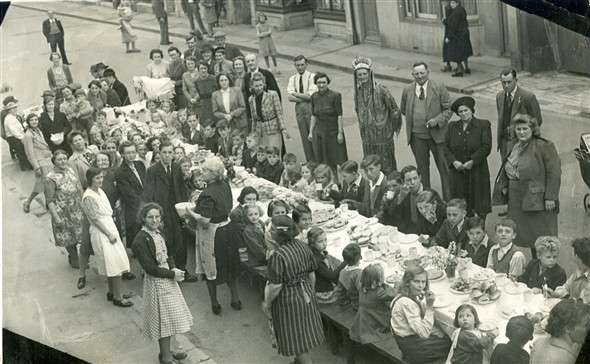
As the Queen’s Diamond Jubilee draws near people are preparing to celebrate. This year there is a whole variety of events to mark the occasion including the lighting of huge beacons right around the country. However, here in Glossop we have kept with the tradition of street parties. Surely no one can resist a party? A chance to have drink, relax and spend some time with friends and family.
The tradition of street parties as we now know as residential events that take place in their own streets seem to have taken off on a large scale in 1919. They were held in July as 'Peace Teas' as a genuine celebration of the signing of the Versailles peace treaty after the First World War. They were tea parties that were focused on a special treat for children in those times of hardship and were quite formal sit down affairs.


These residents led street parties were a popular mass participation and were probably a development of more formal public street dinners that had historically been held, such as for Queen Victoria's Diamond Jubilee in 1897. Then after the Second World War the entire county went street party mad. The craze continued with the coronation of Queen Elizabeth the Second. Street parties have been seen on many occasions since such as the Golden Jubilee and the Royal Wedding last year.

At the end of this month there will be small exhibition in the Glossop Railway Station depicting 60 years of Glossop past and present. There will also be a celebration walk on the 26th May and on the 9th June.

I am looking for photographs of Glossop street parties over the years. It would be great if we could find one from 1953 Coronation.

If you would like to share your photographs memories then please get in touch.