Showing posts with label Samuel Hill-Wood. Show all posts

Tuesday, 19 April 2016

Glossop 1912

We are continuing into 1912....

At the heart of some of the world’s most devastating events, shocking incidents and even the greatest achievements, are the people from Glossop in the year of 1912. Over the coming weeks I will reveal a whole host of staggering facts, stories, eyewitness accounts, and sporting achievements that took place over one hundred years ago.


I would like to first turn to one of the oldest parts of the original village of Glossop. The stone shaft that makes up the main frame of the Old Cross has stood the test of time. It thought to have been placed here around 1157 when the parish of Glossop was granted to hold a court, a fair and a market around the stone cross. Over the centuries it became custom to announce the new kings and queens and other important messages from the cross, after all it was the centre of the town. It was not until the early 1800s when the cotton industry began to develop further down the river when plans were put in place to pursue a new town centre. It was when the new complex at Howardtown was built in 1838 when things really began to change. Over the next few years it was clear the offices and court room along with the fast development of the new cotton mills, Howardtown, by far superseded the original part of the town. Glossop was granted a borough in 1866 and people began to regard Howardtown as the centre of Glossop.

In 1910 it was moved to where it stands today
The Old Cross never bore the Celtic stone cap to begin with. 1910 saw the reign of George V which was announced at the cross like the many Monarchs before him. The officials of the Borough of Glossop wanted to place a cap on the stone cross not only to mark the coronation of the king but to symbolise the unity of faiths. The cross was moved from its previous position as it was tight against the house behind, to where it stands today. The Celtic cross was finally placed on top of the ancient cross in 1912.


The Old Cross in Old Glossop

Monday, 14 March 2016

Olympic Games 2016 - Throwback Football Heroes 1912


Throwback Football Heroes 1912

The country is making final preparations for one of the greatest sporting events, the Olympic Games.  As the last adjustments are being made in Brazil, however, preparations around the country are taking place in order to select the British Olympic Team.

One hundred and four years ago the Olympic Games in 1912 were to be held in Stockholm and in April that year the British Team were to be selected. At that time the sportsmen who were selected were mostly amateur and unpaid, never the less they were the very best of their field.

Glossop has always been highly active in sport over the years and 1912 was no different. April 8th saw Glossop FC (formally Glossop North End) grab a vital point against Grimsby Town as Glossop battled against relegation in the Second Division.

Towards the end of the season, two men attend a match at North Road to observe the team. It is believed they were “tipped off” maybe by a current or ex player of Glossop that the team had obtained some “legend” players. Olympic records show that one of the men was Terry Graham, a man who worked for the British Olympic team as a sort of scout.  No one knows for sure but it is likely that the “tip off” came from Samuel Hill-Wood himself as he still owned the club although he was no longer manager. He was in London most of the time, as he was standing for MP for the High Peak.

By the end of the season Glossop FC just managed to scrape out of the relegation zone by goal difference. Immediately after the season had finish the British Olympic Football Team was announced and on the team sheet were players from Glossop Football Club.  Stockholm 1912 saw many great achievements let’s hope Team GB can do the same this year.

 By Matthew Cox

To Be Continued…

Thursday, 7 May 2015

A Snapshot of Glossop North End's History

  Glossop North End Nets 10 -1 in Four Days

As Glossop North End enters its last preparations for the FA Vase Final vs North Shields to be played at Wembley on Saturday 9th May, I have taken some time in the archives to show some of the forgotten magic of GNE.

The following pieces are taken from a study I was involved in during the preparations Glossop North End's 125th Anniversary. 


In 1899 Glossop North End were fighting for promotion and as they entered the new year a string of wins were waiting for them.


“Glossop journeyed to Darwen in order to meet for the first time the wooden spoonists of the Second Division … without Gallacher and Colvin, the vacancies being filled by Sutcliffe and Sidebottom, the latter a promising reserve player.
Game a very interesting one … the Glossopians did their duty well. The wooden spoonists have two capable backs, whilst Lumsden found some strong opponents on his side of the field. I don’t think I have seem Williams save more effectively, whilst the forwards, although weakened by the absence of Gallacher and Colvin, played most creditably, Donaldson showing a real liking for the company of Whittaker, the Darwen goalkeeper. Sidebottom was brought into the team, and I must say he is the best of the locals – barring Sutcliffe … that have been tried this season.
Glossop North End - The End of Season 1898/99 
McEwen was partnered by Killean for the first part of the game, Rothwell changing places with the latter after an hour’s play. The captain by no means shaped badly in the front rank … personally I like to see him in the rear … he hasn’t quite enough greyhound for a forward. The halves were all right. The two great events of the week have been the severance of Pryce’s connection with the North End club and the suspension of Clifford for a fortnight.” Glossop-Dale Chronicle 3rd March 1899.

Glossop Football Card 1900


“Glossop North End have had a really good week, netting four points in the English League, and improving their goal average to the tune of ten goals to one … fourth in the table. The question seems to arise one more as to whether the team will reach a point sufficiently high in the table to ensure their entrance into the charmed circle of the First Division. It seems to one that Manchester City and Leicester Fosse have the best chance, and Glossop North End and Burslem will be the most dangerous opponents of the Midlanders.
The Gainsborough men gave the North Enders a good game in the first half, only two goals being scored, and the football in the second moiety was spoiled by the heavy downfall of snow. The Trinitarians tried hard, but they were no match at all for the Glossopians … The Glossop goalkeeper is to be complemented on the manner in which he saved the penalty kick … he advanced and turned the shot for a corner after it had scarcely left the kicker’s foot. McEwen was the better back, and the halves and forwards were all on their best behaviour, with the exception of Colvin, who was evidently suffering from the effects of his recent injuries, and was off form altogether.
On Tuesday the unfortunate Darwen team visited Glossop. Goalkeeper Whittaker failed to turn up and Woolfall took his place … The game was uninteresting … the visitors were only dangerous on three or four occasions ... Colvin was in better trim, and every man played well, though they let their opponents down more lightly than they might have done.”
Glossop-Dale Chronicle 10th March 1899.


Many thanks again to the club & members for permission to use this content. Copyright Belongs to Glossop North End AFC. 


Complied by Matthew Cox - I wish all the club, players management & officials a huge congratulations on their achievements already this season by winning the double of the league & the league cup & the very best for Saturday. VIVA GNE! - It is in no doubt that this season is the best and I mean the very best in living history. To be a part of it was hugely exciting both as a supporter, fan and historian alike. 

From the words of my Dad "Win or Lose Have A Booze!" - FA Vase Final 2009

You can find me on Twitter @Matthew_R_Cox or @GlossopTours


Monday, 23 March 2015

Glossop North End AFC - Samuel Hill-Wood

The Legends of Football - Part One - Lost Heroes, Treasured Pride by Matthew Cox

Sir Samuel Hill-Wood, born on 21 March 1872 the son of Samuel Wood and Anne Kershaw Sidebottom, lived a long and prosperous, public life.

From early childhood Samuel Hill-Wood known locally as “Sammy” showed an unbelievable understanding of his family’s cotton business and how it was constructed and managed. Inspired by his father and grandfather to continue the business he was sent to be educated at Eton College. It was here where Sammy first acquired his obsession with sport. On returning from College, Sammy was fascinated to hear that Glossop had set up their own football club (Glossop North End) and that some of his father’s employees were involved. In response he organised a team representing his fathers company named Howardtown F.C. He played alongside employees in local leagues which consisted of teams from butchers, victuallers and rival mills. As the football game grew nationally, Howardtown F.C was not enough for Sammy and he began talks with other clubs. It was around this time rumours began saying that Samuel Hill Wood wanted to “buy” a football club.

Sir Samuel Hill-Wood in 1928
In April 1888 his father, Samuel Wood died aged 69; with this Sammy inherited his fathers business at Howardtown mills, life savings and reputation. This gave him the incentive to carry out his ambition to create a high class football club. Sammy delivered his proposal to the founders of Glossop North End and it was accepted almost immediately. He hand selected a small team of men that consisted of a secretary, two trainers and a scout.  This “Scout” travelled the land observing the top teams of the time such as Manchester City and Preston North End for the perfect players. Sammy expressed in a telegram that, “money is the key “; a quote that still applies today. Sammy also pulled some strings in his cricket line of work, persuading fellow cricketers to come and play for him. By 1890 Glossop North End were playing in the North Cheshire League and things were looking good.

In the early 1800s the game of football was used as tool to encourage young men to go to church and to maintain a “team” spirit on the day of rest. However by the late 1800s the sport had developed not only into a national game but an entertaining enterprise. Samuel Hill Wood had spotted not only an opportunity for investment, but also advertisement on a national scale. When Sammy turned 22 he injected a huge sum of money into the club, big enough in fact to start paying wages and turned the club professional. 

This same year also saw Sammy make his debut in cricket playing for the Derbyshire County first team.  Glossop North End were making national headlines when they entered the Second Division of the Football league.

Sammy loved the attention he and the club were getting so much so he boosted the club yet again with another financial push. 

This gave them the edge they needed drafting in some of the best players from teams from all over the land and even overseas. Building in confidence the team began to draw in huge crowds which brought the money rolling in. This could be seen when Glossop North End played local rivals Manchester City at North Road. Just over 7,000 were in attendance to see City win in a narrow victory over Glossop of 2-1. From this one match they had taken £150.18s.4d on the turnstiles alone
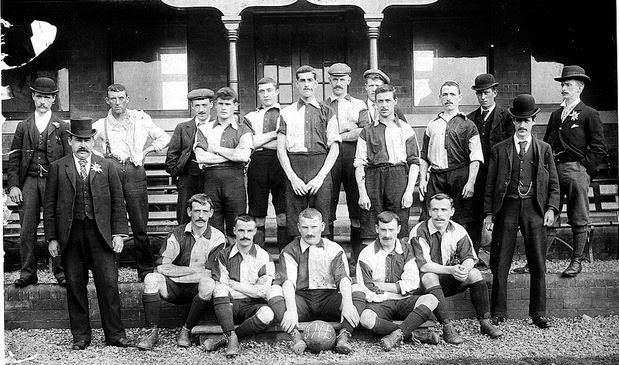
Glossop North End - The team who won promotion in 1899
.
There was a huge uproar not just nationally but worldwide when Glossop North End made it into top flight football. In 1899 the nation stared in disbelief that a small town deep within the hills were battling it out on the pitch with some of the nation’s top teams from some of the wealthy cities. This could not have been possible without Samuel Hill Woods astounding insight, a true pioneer of sport. Sammy continued to work closely with the club even taking them to a F.A Cup Quarter Final in 1909.

In 1910 Sammy began a new career as a conservative MP for the High Peak. In 1913 he was involved in top secret government plans and had an early insight of what would unfold to be the Great War. So with that in hand he returned to Glossop and began to sell his shares in the club. But the influences of Sammy remained in Glossop as the "Hillmen” or “Wood’s Men” began their battle in the F.A Cup 1913. Even with Sammy gone from the club, the reputation remained as a record of 10,736 people flocked to see Preston North End at North Road for the F.A Cup 2nd Round game.

Throughout the years to this day the legend of Sir Samuel Hill-Wood remains. As we celebrate entering the Final at Wembley of the FA Vase, the “Hillsmen” are a distinct reminder of that great pioneer. Just think Sammy had his own football club at the age of 18 and in the space of 14 years his club, Glossop was and still is to this day the smallest town in England ever to have a team grace the top flight football league.

By Matthew Cox 

Follow me on Twitter: @Matthew_R_Cox    or    @ GlossopTours  for more updates about this historic club.


Monday, 23 February 2015

Day Trip to Glossop? - Glossop Advertiser 1912

Day Trip to Glossop For a Sixpence

The summer is now not to far away, however, day trippers continuously pour into our town throughout the year. Things have not changed for well over a century because last summer I found a column in the Glossop Advertiser back in 1912, by a local columnist expressing his feelings about day trippers who came from Manchester to Glossop for a sixpence.  


"The summer season is now in full swing, that especially as regards the running into Glossop of cheap excursion trains on Sundays is concerned, a note of warning should be thrown out to certain visitors of both sexes who come into this pleasant Derbyshire town. Let it be clearly understood that there is not the slightest desire to put forth any argument against the introduction into Glossop of trippers. But we echo the public feeling that those cheap excursionists should behave themselves and that failing to do so the law should step in and administer a lesson not readily forgotten. It seems to have occurred to the minds of say Mancunian visitors that they are at liberty to turn Glossop into a bear garden and we are bound to say that the local justices have not as a rule made ‘the punishment fit the crime’.


It is true that, as the greatest of England’s poets says, “The quality of mercy is not strained”. That is the rule, but to most rules there are exceptions and we are inclined to believe that with regard to Sunday delinquents brought before the Glossop Police Court the merciful quality has distinctly been strained. There is a considerable proportion of these sixpenny trippers that can fairly and honestly be designated a nuisance. If people wish to escape on the Sunday from Manchester or elsewhere to healthful Glossop we admire their decision, but having arrived in the town, having availed themselves of the privilege of cheap access thereto, having left a smoke-begrimed city for the delights which Nature affords, the least they can do is to conduct themselves with propriety. But many of them do not, and they should be taught to recognise the force of the law.

Damaging grass lands, breaking trees, card playing, footballing in the public streets, and so on, are items of objectionable amusement that have been practised by a certain class of visiting hooligans, whose absence would be far preferable to their company. We want to see established by the magistracy the preservation of Glossop’s good name, and therefore we hope that stringent penalties will be in future imposed upon all offenders. Readers who revert to the report in other columns of this issue of the ‘Advertiser’ of the proceedings in the Glossop Police Court will see that the local Justices have made up their minds to stand no further nonsense. Their decision is quite right and proper, and we commend them for having arrived at it. The police have done, and are doing, their level best to stamp out the illegal and unwarrantable doings of the class of persons to whom we have so pointedly alluded. It has been pretty well accepted as a truism that there is a black sheep in every flock. Biblical instruction shows the vast difference and distinction between the sheep and the goats. In Glossop the sheep from Manchester are always sure of a cordial welcome, the goats – well, may either stay at home, or be sure either of being substantially fined or relegated to one of His Majesty’s hotels, which are usually designated by another expression."


Have things changed?


Complied by Matthew Cox

Monday, 2 February 2015

Samuel Hill-Wood of Glossop: The All-Round Sportsman


An All-Round Sportsman Puts Racing On The Map

Heavy Weapon
Samuel Hill-Wood was a true lover of sport he not only triumphed in football and cricket but in greyhound racing too. This is a portrait of Samuel’s successful coursing Greyhound, Heavy Weapon. He was born in 1905 sired by the winning dog, Wartnaby, who sired a number of useful coursing dogs, out of Garbitas. He was the great-grandson of one of Colonel North’s famous Greyhounds, Young Fullerton, who was the same way bred as the legendary Fullerton, arguably the greatest Greyhound of all time, winning three Waterloo Cups and dividing once in five visits to Altcar.

Heavy Weapon was owned by Samuel the all-sports man, after leaving Glossop North End he captained the Derbyshire cricket team for three seasons and became chairman of Arsenal Football Club in 1929. He was also passionate about coursing but in some quarters was apparently not a popular owner. In 1913 he was considered a ‘parvenu’ by the Stud book correspondent as he had owned dogs for only 11 years!

Heavy Weapon was declared the winner of the Waterloo Cup in 1910 running in the final against J W Fullerton’s Full Stream who was drawn distressed. He also proved very useful as a stud dog siring. He was owned by Edward (later Sir) Hulton, who set up the first picture library.

Hill-Wood won the Waterloo Cup again in 1913 with "Hung Well". His dogs were trained by Denny Smith, who trained more winners than anyone apart from Harold Wright.

Benacre Cup
Heavy Weapon’s portrait was painted by Wright Barker (1864-1941) in circa 1911. A painter of large hunting and sporting scenes, animals and rural landscapes that often featured cattle, he exhibited at the Royal Academy and the Royal Society of British Artists.

In Addition to his Waterloo Cup success, Heavy Weapon also won the 15ct gold Benacre Cup in 1909. The portrait achieve £12,500 in auction two years ago along with Benacre Cup which was also sold for a sum of £11,400. The items went to auction after being passed on by a decadent of Samuel Hill-Wood and some of the proceeds went to the retired greyhound charity.

By Matthew Cox    Check out glossoptours.moonfruit.com