Showing posts with label Duke of Norfolk. Show all posts

Friday, 6 May 2022

Homeward Bound: Bringing Glossop's History Home

Hello, it's been a while.  Thank you for being here. Being back in physical archives, collections and long lost boxes of stuff seems better than ever. It feels like stories are pouring out of every corner and I am making  new discoveries on a daily basis. I have so many  projects to complete and lots to share. The last two years, however, have allowed me to venture far and wide, dipping my toe into collections and archives from around the world. Yet nothing beats finding something and getting up close and personal with it.

I now have access to over 300 items that have all got association with our town. These come from an array of locations from all over and during the last 8 weeks I have carefully coordinated and negotiated the release of these such items. My plan is to return them to Glossop for a set period of time. This would allow locals and visitors to see some of our lost artifacts, discover their stories attached to them and you get to see my life's work coming into fruition once again.

Where have I been? I have been working hard on bringing history to life through social history. I have continued my work throughout the pandemic and extended my sessions, presentations and experiences to people all over the High Peak as part of a project to combat loneliness, online sessions for schools, in and out of care settings and using the power of reminiscence to people in our community who suffer from dementia. I am very proud of the success I have had and even kindly received awards for my unique experiences. I have lots of great opportunities ahead to explore further. 


I am now opening back up to the wider community but I don't expect to pick up where I left off. During the early part of 2020 right up to two days before lockdown I had 4 sessions where I had just over 500 visitors, locals, schools and partners joined me for presentations and experiences. I hope to gradually grow to that potential again but as always I want to improve how to deliver things. One of the major downfalls is I can't seem to find anywhere suitable to build a ground floor space to call 'home'. Over the past 6 years I have even had full support from businesses and private backers to provide a full 2 years of rent to enable me to build the foundations but to no avail. All I need is some space. So I have to think outside the box again as I cannot wait around as there is so much for you to see, feel, do and discover. 
I have been returning to the archives both in a personal and national capacity. From cool cupboards to vast catacombs of interlocking vaults that emanate a real  Da Vinci Code vibe! So I have found some real gems during lockdown and now to not only see some of them in person but to grant the door to be wedged open to allow their birthplace to see them is monumental. This is just what I have aimed for my entire working career and passion to achieve. There is a world of items that haven't seen the light of day, some more than half a century and some have never been in the public eye. I am planning to show some of these items over my next series of talks and presentations, starting with 'Glossop's Fading Footprint'  and 'Stepping into History' . As soon as I can find suitable premises I now have permission from 6 archives to loan items to go on show. 

What is there to see? There is a wide range of items from documents, images, buttons, badges to paintings, personal accounts, patterns, cotton, grand chests and even a silver casket! There are remains of a ship that was contracted by the Woods family, that would ship cotton which I stumbled across in a shed when I was on holiday! All the items have a personal link to the town. There are even some items of great historical importance like a personal letter from the Duke of Norfolk while he was residing at Glossop during the summer. That's right the Norfolks spent time in the summer here! The letter is over 160 years old and mentions grand parties and new roles for the servants. More importantly it reveals the true position and freedom of Thomas Ellison. There is a diary linking Glossop and a visit from William Wordsworth. Personal items from Edward Fitzalan-Howard, 1st Baron Howard of Glossop. The list is growing daily and I hope that I can shed light on them for you too in the not so distant future.


Before I go, there is a bear on the hill! Sounds like a children's book doesn't it? But there really is a brown bear right here in Glossop. Why? Well I am just about to write his story as requested. So hold tight for more soon. But unlike my other artifacts, he is still here in his home from home surroundings. 

Sorry it has been so long but health has tried to get in my way but resilient as always I pledge my life to the town. I have strong and deep roots in Glossop but I'll  continue to open up the past though new innovative ways and means to allow you to step inside, to get a unique glance at the past!

Thank you for your time,

Kind Regards Matthew.  

Want to know more? Get in touch, involved or know of some space I can use or rent? 

Let me know at glossop6@googlemail.com 

Thursday, 1 August 2019

Announcement: Glossop History - The Way We Were


I have been working on a verity of different projects over the last twelve months. From documenting rare and previously undiscovered finds, rediscovering documents and artifacts in private or locked or away collections, providing talks to clubs and schools as well as providing assistance with the ever threat of damage to our local heritage.

This is around my other passion which working with individuals who suffer from dementia. I work closely with the community and provide a ward winging experiences and sessions to engage and enhance a person’s day. This enhances the opportunity to social interaction and the ideal environment to reminisce, remember personal memories and create new ones along the way.


There will be two presentations this year that will be of note and I cordially invite you to join us. The first is on the 26th October 2019 at Partington Theatre, Henry Street, Glossop. This will be an evening presentation/ workshop titled The Way We Were. It is the perfect combination of both of my passions. We will have a brief look at our social history, local events and images that are proving to be somewhat iconic.


There will be more updates soon regarding the latest request for permission for more housing in the old part of the town which is set to destroy not only history of our town but the skyline forever.


Thursday, 23 June 2016

Will Your Vote Change the Country and Glossop?

Do people realise just how important this vote is?

Personally I don't think there has been any true leader during the latest campaigns. The fights between the leaders have all been seen by us all but why don't they fight like that each and every day in our own and european parliaments? We might of never needed this referendum in the first place.

Why have a referendum? Was there concern about our european status in the first place?

I don't know what the verdict will be but I just hope it gives a boot up the government to show, we the people really do care, hear and work for our country and yes we do have a voice. I hope everyones voice is heard come the result. That would be one of the best things to come of this.

Enough with the politics....
Will it change the Glossop landscape?

Yes. Still holding a very deep breath for the chimney to come down, work should of started this month. I don't think there will be a bypass any time soon... Plans have been in the works for 80 plus years so why would they start now?


Do you think Glossop will change and develop for the better?

The History of the Chimney

Hidden Gems of Glossop

Figureheads of Glossop

Tuesday, 19 April 2016

Glossop 1912

We are continuing into 1912....

At the heart of some of the world’s most devastating events, shocking incidents and even the greatest achievements, are the people from Glossop in the year of 1912. Over the coming weeks I will reveal a whole host of staggering facts, stories, eyewitness accounts, and sporting achievements that took place over one hundred years ago.


I would like to first turn to one of the oldest parts of the original village of Glossop. The stone shaft that makes up the main frame of the Old Cross has stood the test of time. It thought to have been placed here around 1157 when the parish of Glossop was granted to hold a court, a fair and a market around the stone cross. Over the centuries it became custom to announce the new kings and queens and other important messages from the cross, after all it was the centre of the town. It was not until the early 1800s when the cotton industry began to develop further down the river when plans were put in place to pursue a new town centre. It was when the new complex at Howardtown was built in 1838 when things really began to change. Over the next few years it was clear the offices and court room along with the fast development of the new cotton mills, Howardtown, by far superseded the original part of the town. Glossop was granted a borough in 1866 and people began to regard Howardtown as the centre of Glossop.

In 1910 it was moved to where it stands today
The Old Cross never bore the Celtic stone cap to begin with. 1910 saw the reign of George V which was announced at the cross like the many Monarchs before him. The officials of the Borough of Glossop wanted to place a cap on the stone cross not only to mark the coronation of the king but to symbolise the unity of faiths. The cross was moved from its previous position as it was tight against the house behind, to where it stands today. The Celtic cross was finally placed on top of the ancient cross in 1912.


The Old Cross in Old Glossop

Tuesday, 2 February 2016

Glossop Connections - Charles Calvert, Raisley Calvert & William Wordsworth

Glossop Famous Connections
The Calvert Family - A Celebrated Artist. Charles Calvert Junior.

In my last post I had mentioned that Charles's first son, was Frederick Baltimore Calvert but it is in fact it was his second. I have managed to trace that Charles had in fact eight children. His first child was also born at Glossop Hall and was named after his father on 23rd September 1785. Records show that Charles Calvert Junior was taught at the hall itself in Glossop, Derbyshire. He became an apprentice to his father within the family cotton business. He seems to become a very successful cotton merchant until, however, he abandoned cotton for art and became a landscape painter.

His influences for this drastic change of mind came from his uncle, Raisley Calvert who was a renowned sculptor. Raisley Calvert, was in fact, the Steward to the Duke of Norfolk, and looked after his estates at Greystoke. Raisley not only had a great career but great connections as he was a close friend and admirer of William Wordsworth. They were at Cambridge University together where they became very good friends, this is their story...

William & Raisley 
William Wordsworth
William was sent to school at Hawkshead where he made friends with a boy from Cockermouth called William Wordsworth. The two boys were the same age and from similar backgrounds. Wordsworth’s father was an agent for Sir John Lowther, the Earl of Lonsdale. When they left school Wordsworth went to Cambridge, travelled abroad and lived for a while in London while William joine
d the Duke of Norfolk’s Regiment (then known as the 12th Regiment of Foot) of the Militia. In 1791 William’s father died, and he and Raisley inherited a sizeable fortune.
In July 1793 William Calvert invited Wordsworth to accompany him on a tour of the West Country, all expenses paid. Wordsworth wanted to become a poet but had no job and no income. He eagerly accepted William’s offer and the two young men set off. They spent about a month on the Isle of Wight where they watched the English fleet preparing for the war with France. They then headed west, but near Salisbury their horse dragged the carriage in which they were travelling into a ditch and it broke into pieces. The two men decided to separate. William took the horse and rode home to Keswick while Wordsworth set off on foot and walked across Salisbury Plain. He travelled through very bad weather, rested at Stonehenge and had some visions: an experience which led to the writing of his poem ‘Salisbury Plain’. Later that year he visited William and his brother Raisley at their family farm at Windy Brow on the slopes of Latrigg near Keswick. 
In early April of the following year William invited Wordsworth and his sister, Dorothy, to stay at Windy Brow. Wordsworth and Dorothy were delighted. They had been separated since childhood. After the death of their mother in 1778 Dorothy had been sent away to live with relatives. They had met up again in Halifax for six weeks but now they looked forward to a holiday together. They travelled by coach to Kendal then walked the eighteen miles to Grasmere and a further fifteen miles to Keswick. William Calvert was away with his regiment but Wordsworth and Dorothy stayed with his tenants at the Windy Brow farmhouse (Right). Dorothy loved staying at Windy Brow. She wrote to her friend, Jane Pollard, saying how delighted she was with the situation of the house.
She described, in glowing terms, the view from her window which looked out over the River Greta, Keswick town and Derwent water. She described how cheaply she and her brother could live, with milk for breakfast and supper and mainly potatoes for dinner. There was a terrace path on the slopes of Latrigg, above the house, where Dorothy enjoyed walking and admiring the view of the vale of Keswick . They spent a month at Windy Brow and it was during this time that Dorothy first started to copy out Wordsworth’s poems: a job which she would continue to do for the rest of her active life. 
Later in 1794 Wordsworth returned to Windy Brow to find that William’s brother, Raisley, was very ill with consumption. William was with his regiment in Tynemouth, Northumberland. Wordsworth suggested that he might accompany Raisley on a visit to Portugal to improve his health if William would cover the costs. At the same time Raisley decided to write a will. He left everything to his brother except for a £600 legacy (later increased to £900) to Wordsworth. Wordsworth wrote to William asking for money for the trip to Portugal. William responded immediately and offered to pay all costs. Wordsworth and Raisley set off but they only got as far as Penrith and had to turn back the next day because Raisley was worse. Wordsworth stayed to nurse Raisley at Windy Brow but Raisley died in January 1795. Raisley’s legacy was a valuable asset for Wordsworth at this time.

There are records to show the visited family and went to a "hunting lodge" which is strong evidence that they visited Glossop at this time. During the early periods of Glossop Hall it was used as a holiday home and a hunting lodge. it is just wonderful to think that this great man made his presents in Glossop itself.

This friendship was so strong that William Wordsworth visited Raisley on his deathbed and personally cared for him right up until his death in 1794. Unknown to William, Raisley had left him a legacy of nine hundred pounds, a small fortune of the day, as a mark of gratitude. William never forgot this as he wrote later:

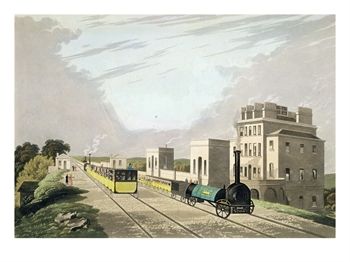
 Manchester and Liverpool Railway in 1825 by Charles Calvert


"Calvert! It must not be unheard by them
Who may respect my name, that I to thee
Owed many years of early liberty.
This care was thine when sickness did condemn
Thy youth to hopeless wasting, root and stem."


Charles Calvert Junior became a great landscape painter and teacher of art. One of his most famous paintings was of the Manchester and Liverpool Railway in 1825. He was one of the founders of the Manchester Royal Institution now the Manchester City Art Gallery. He gained the Heywood gold medal for a landscape in oil, and the Heywood silver medal for a landscape in watercolour. He loved to spend his spare time in the Lake District. When he died he was buried at Bowness-on-Windermere.

Compiled By Matthew Cox

In Addition:

William Wordsworth died in 1850. A few years later the Greta Bank estate was sold to Mr Anthony Spedding. The house at Greta Bank was substantially rebuilt and has now been converted into apartments known as ‘Brundholme Country Houses’. Calvert’s Bridge has given its name to the nearby ‘Keswick Bridge’ Timeshare Lodges. In 1978 John Fryer Spedding set up the Calvert Trust to provide outdoor adventure activities for people with disabilities. The name was chosen in memory of Wordsworth’s benefactor, Raisley Calvert, ‘to represent friendship, support and the desire to help somebody to fulfill their potential’. The Windy Brow Farm where Wordsworth nursed Raisley is now owned by the Trust. Calvert was an interesting character. He had some influence on the Lake Poets, he took a keen interest in agricultural development and he was a kind and generous friend to those around him.

More Information & Sources

Calvert, Charles (1785–1852), landscape painter, born at Glossop Hall, Derbyshire, on 23 September 1785, was the eldest son of Charles Calvert (1754–1797), land agent, and his wife, Elizabeth Holliday (1751/2–1842). His father was agent of the duke of Norfolk's estate in Derbyshire and an amateur artist. Charles Calvert senior died on 13 June 1797 and was buried in St Mary's churchyard, Manchester. Calvert began business as a cotton merchant in Manchester, having been apprenticed to the cotton trade, but abandoned commerce for art and became a landscape painter. He was instrumental in the foundation of the Manchester Royal Institution (which later became Manchester City Art Gallery) and gained the Heywood gold medal (awarded to local artists) for a landscape in oil, and the Heywood silver medal for a landscape in watercolour. The Manchester Courier reported in 1828 that, of local artists, Calvert's paintings were the most consistently sold. He was not well known outside his region, however, and exhibited only two works in London, one of which, at the British Institution in 1825, was entitled Near Rustom, Cheshire.

Calvert devoted much of his time to teaching, and spent the remainder painting in the Lake District. Although confined to his bed in later years, he continued to paint landscapes from memory. He died at Bowness, Westmorland, on 26 February 1852, and was buried there. Examples of his work are in the Victoria and Albert Museum, London, and Manchester City Galleries.

Charles Calvert's brothers included , actor and lecturer on elocution, , surgeon, Henry Calvert (1785–c.1869), sporting and animal painter, and Michael Pease Calvert, painter. He was father-in-law to the portrait painter .

In the Dictionary of National Biography Raisley Calvert (bap. 1773, d. 1795), friend and benefactor of William Wordsworth, is incorrectly described as Charles Calvert's younger brother. Raisley Calvert was baptized on 16 September 1773, the younger son of Raisley Calvert senior (1728/9–1791), steward of the duke of Norfolk's estate at Greystoke Castle, near Penrith, Cumberland. His elder brother was William Calvert (1771–1829), who was at school with Wordsworth at Hawkshead, Lancashire, where he later became schoolmaster. On the death of his father, William Calvert became a man of independent means, inheriting, with other property, the estate of Bowness on the east shore of Bassenthwaite, near Keswick. Raisley Calvert inherited from his father several farms near Keswick, the income from which was held in trust until he attained his majority in 1794. He was admitted to Magdalene College, Cambridge, on 14 February 1793, where he became friends with Wordsworth, but left soon afterwards with a resolve to educate himself by travel on the continent. Though described in the Dictionary of National Biography as a sculptor, no evidence has come to light of any works sculpted by Raisley Calvert. On falling ill with consumption, he returned to the Lake District, where he died at Penrith after 7 January 1795, when Dorothy Wordsworth mentioned that he was ‘barely alive’ (Letters of William and Dorothy Wordsworth, 139). He was buried on 12 January. In his will, signed on 23 October 1794, Raisley Calvert left £900 to Wordsworth. The poet subsequently wrote a sonnet, ‘To the Memory of Raisley Calvert’, and later mentioned him in lines 349–67 of the thirteenth book of The Prelude:
A Youth (he bore
The name of Calvert.
(lines 349–50)


Sources  

W. E. A. Axon, rev. L. R. Houliston, Art Journal, 14 (1852), 150 · S. Urbans, GM, 2nd ser., 37 (1852), 630 · T. Fawcett, The rise of English provincial art: artist, patron and institution outside London, 1800–1830 (1974) · G. Meissner, ed., Allgemeines Künstlerlexikon: die bildenden Künstler aller Zeiten und Völker, [new edn, 34 vols.] (Leipzig and Munich, 1983–) · M. Hall, The artists of Cumbria (1979) · D. Child, Painters in the northern counties of England and Wales (1994) · Bryan, Painters (1903–5) · Redgrave, Artists · Mallalieu,Watercolour artists · M. H. Grant, A chronological history of the old English landscape painters, rev. edn, 8 vols. (1957–61) · IGI · H. M. Cundall, A history of British water colour painting (1908), 193 · The letters of William and Dorothy Wordsworth, ed. E. De Selincourt, 2nd edn, rev. C. L. Shaver, M. Moorman, and A. G. Hill, 8 vols. (1967–93), vol. 2, pp. 81, 97, 126n., 139–40 · W. Wordsworth, Poems, in two volumes, and other poems, 1800–1807, ed. J. Curtis (1983), 151–2

Wednesday, 16 September 2015

Glossop Cotton Queens - From Miss Glossop to Miss England 1930


The Cotton Queens 


According to a recent survey over 18 million people attend music festivals here in the UK every year. Music, arts and film festivals are on the rise and now attracting global attention bringing in the biggest names. History festivals are now starting to crop up here and over thirty took place over the summer.

There have always been festivals in Glossop some festivals have survived the test of time and some have now faded. It was not up until recently that we celebrated the May Cotton Queens. This festival celebrated just one thing, cotton. This one day in May was dedicated to a huge, colourful parade throughout the town. It was not only to celebrate the towns industry but an advertisement! A huge competition would take place between all the mills in the valley to determine the best cotton queen. The mill owners would choose the fairest girl within their business to showcase their finest product, similar to the Miss World competitions today.

They would parade through the town on the back of rickshaws and flatbeds and later vans. Some would depict a moment in history and others would show fashion, similar to the floats we have today at carnivals. It would then be up to a panel of judges normally including the Mayor to announce and crown “Miss Glossop”.

Then later in June it would go National a massive competition to find the “Cotton Queen of England”. I have found a report in a 1930s National newspaper, a truly fascinating little piece of our history, how “Miss Glossop” got to the final.

Cotton Queen 1930 Miss Glossop to Miss England  


In May 1930 Cotton Queen Festivals took place all over the North West of the country. Glossop held one of the largest; over 60 queens were presented that year from far and wide. The competition was fierce; competitors came from Manchester, Hyde and Cheshire. The competition was won by Miss F. Lockett who came from Newton Moor Mills of Hyde, a weaver aged 20. Miss Lockett was crowned ‘Miss Glossop’ and was paraded through town and was done so with,  “full of delight and splendor” according to a local reporter.

In June following on from the regional events, the Nationals took place. As I mentioned last week, I have found a report in a National newspaper that covers the Final in 1930. The Grand final of the search for “Miss England” took place in the Tower Circus, Blackpool. A total of 40 queens made it to the final stage where they were put “on display” and asked to do a variety of task, properly just walking round!

The panel of judges cut the 40 queens down two and took time to select a winner. The two finalists were, “Miss Salford” Miss E. Knox a clerk from Ordsall Dye Works in Salford and “Miss Glossop”.

The winner was selected by the Mayoress of Blackpool and was crowned “Miss England”. The top prize was given to “Miss Glossop” and was put on the grand throne in the centre of a massive parade. According to the news article, “ over 400,000 people flocked to see the Cotton Queen of England, the storm clouds retreated and the glorious sun shone over the queen of queens and her people”.

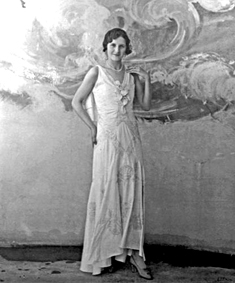
Cotton Queen Frances lockett in elegant 1930s poseMore than 20,000 people lined the streets when Frances Lockett returned to Hyde after being crowned the first Cotton Queen of Great Britain. Such was the town’s pride that she was treated like a member of the Royal Family.

Yet Frances was actually a Derbyshire girl. At the time of her success she lived, quite aptly, on Queen Street, Hyde. But she was born at a house on Gladstone Street, Glossop, and spent her infancy there.

Indeed, because of the way the competition was organised by the Daily Dispatch (a newspaper which folded in 1955 and was ultimately absorbed by the Daily Mail she won her title as Miss Glossop and Hyde.

"The final took place at the Tower Circus, Blackpool, on 28th June, 1930. Frances, wearing an ivory-coloured ball sheen gown designed in the latest Parisian style by Kendal Milne of Manchester, was described as tall, slim and pretty. She certainly made her mark on the judges – the Marquis of Donegal, Lord Inverclyde and JW Tout MP – and there was a huge roar when it was announced that Miss Glossop and Hyde had beaten the other 17 entrants.
Before the crowning ceremony, Frances changed into a gown that was 50 per cent cotton and 50 per cent satin, with red Lancashire roses forming a line from the shoulder."

The train was white-edged with ermine, caught at the neck with golden cords. The lining was golden also.

Mrs GW Gath, the Mayoress of Blackpool, placed the crown on Frances’s head. Made of gold lined with red velvet, it was set with rubies and diamonds. She also received a portable gramophone, and a silver dressing case on behalf of Blackpool Corporation. The people of Hyde were ecstatic and thousands lined the streets for the victory parade, which began at Frances’s place of employment, J and J Ashton’s Mill, off Ashton Road.

Overnight, Frances went from mill girl to celebrity. A cotton queen waltz was written in her honour and her likeness appeared on specially produced Queenella handkerchiefs. However, she was much more than a clothes horse. As articulate as she was elegant, Frances wrote and delivered speeches promoting the value of cotton produced by British workers.Drawing huge crowds wherever she went, Frances spoke at West End theatres, the British Fashion Ball at Covent Garden and British Cotton Textile Exhibition at White City.


A Clip of 1936 Cotton Queen Final can be seen here: http://www.britishpathe.com/video/cotton-queen-aka-blackpool

By Matthew Cox

Check Out Our Events & Projects at glossoptours.moonfruit.com


Monday, 23 February 2015

Day Trip to Glossop? - Glossop Advertiser 1912

Day Trip to Glossop For a Sixpence

The summer is now not to far away, however, day trippers continuously pour into our town throughout the year. Things have not changed for well over a century because last summer I found a column in the Glossop Advertiser back in 1912, by a local columnist expressing his feelings about day trippers who came from Manchester to Glossop for a sixpence.  


"The summer season is now in full swing, that especially as regards the running into Glossop of cheap excursion trains on Sundays is concerned, a note of warning should be thrown out to certain visitors of both sexes who come into this pleasant Derbyshire town. Let it be clearly understood that there is not the slightest desire to put forth any argument against the introduction into Glossop of trippers. But we echo the public feeling that those cheap excursionists should behave themselves and that failing to do so the law should step in and administer a lesson not readily forgotten. It seems to have occurred to the minds of say Mancunian visitors that they are at liberty to turn Glossop into a bear garden and we are bound to say that the local justices have not as a rule made ‘the punishment fit the crime’.


It is true that, as the greatest of England’s poets says, “The quality of mercy is not strained”. That is the rule, but to most rules there are exceptions and we are inclined to believe that with regard to Sunday delinquents brought before the Glossop Police Court the merciful quality has distinctly been strained. There is a considerable proportion of these sixpenny trippers that can fairly and honestly be designated a nuisance. If people wish to escape on the Sunday from Manchester or elsewhere to healthful Glossop we admire their decision, but having arrived in the town, having availed themselves of the privilege of cheap access thereto, having left a smoke-begrimed city for the delights which Nature affords, the least they can do is to conduct themselves with propriety. But many of them do not, and they should be taught to recognise the force of the law.

Damaging grass lands, breaking trees, card playing, footballing in the public streets, and so on, are items of objectionable amusement that have been practised by a certain class of visiting hooligans, whose absence would be far preferable to their company. We want to see established by the magistracy the preservation of Glossop’s good name, and therefore we hope that stringent penalties will be in future imposed upon all offenders. Readers who revert to the report in other columns of this issue of the ‘Advertiser’ of the proceedings in the Glossop Police Court will see that the local Justices have made up their minds to stand no further nonsense. Their decision is quite right and proper, and we commend them for having arrived at it. The police have done, and are doing, their level best to stamp out the illegal and unwarrantable doings of the class of persons to whom we have so pointedly alluded. It has been pretty well accepted as a truism that there is a black sheep in every flock. Biblical instruction shows the vast difference and distinction between the sheep and the goats. In Glossop the sheep from Manchester are always sure of a cordial welcome, the goats – well, may either stay at home, or be sure either of being substantially fined or relegated to one of His Majesty’s hotels, which are usually designated by another expression."


Have things changed?


Complied by Matthew Cox

Tuesday, 17 February 2015

History of the Dinting Arches

A History of Glossop Railway Line & Beyond..


Part 4 of 6 -  Dinting Arches

The arches have recently under gone major works to maintain, strengthen and preserve the iconic, working structure.

The remarkable structure is part and parcel of the Glossop skyline and has been for over a hundred years. To survive this long it has been modified in several ways and yet still maintains its historic
feel and look.

The viaduct was strengthened with new bearings installed along with repairs to the steel, brickwork and masonry, finished with a new lick of traditional olive green paint.

Dinting Arches originally formed part of “The Sheffield, Ashton-Under-Lyne and Manchester Railway”. The railway was opened from Manchester to as far as Godley in November 1841. The foundation stone of Best Hill Viaduct (Broadbottom) was laid by John Chapman Esq. on Thursday 17th February 1842. Then on the 10th December that same year trains ran from Godley to Broadbottom. It took a further two years to complete the Dinting Viaduct and the first train passed over on August 8th 1844.

There were originally sixteen arches; five of them were constructed of Baltic timbers each spanning 125 feet. The rest built of stone along with the stone pillars that exist today. The wooden arches stood 121 feet from the river bed.

The original wooden Dinting Arches
A tremendous tragedy took place in the evening of 18th September 1855 when a train on a journey from Belle Vue stopped on the arches when three passengers stepped out and fell to their deaths.

The wooden arches needed to be strengthened in the 1850s with tie rods but this was not good enough so they were replaced by the wrought iron girders you can see today. Further strengthening took place in 1919 for the requirements after the First World War when heavier goods were imposed. The brick pillars were installed and some of the stone arches were filled in with bricks for added support. The entire works cost over £41,000 some 93 years ago.
The viaduct after 1919

The last major work was carried out in the 1950s in preparation for the electrification. The first electric train passed over in 1954. The recent update cost around  £6.4 million pounds which was part funded and developed by Network Rail, now enabling the viaduct to last for many more years to come.

Matthew Cox

Friday, 13 February 2015

A History of Dinting Station


A History of Glossop Railway Line & Beyond..


Part 3 of 6 - Dinting Station - "Rich Past, Present & Future"

The first train to arrive at Dinting Station was on 24th December 1842. In the early days of travel the line from Manchester to Sheffield terminated at Dinting, however, in those days the station was in fact called Glossop. Then the traveller would then have to board a coach and horses for the remainder of the way which made the total travel time about 5 hours.


On the 9th June 1845 the one mile branch to Glossop opened for 
goods traffic but because it was built by the 13th Duke of Norfolk it did not have to obtain an Act of Parliament. The former “Glossop” station became known as Dinting. The first station was a wooden structure until it was replaced by a permanent building in 1847. Another outer building was created and was known at “Glossop Junction” as well as an ornate engine shed. A coaling stage was created and a series of goods yards and shunting bays leading to Mottram Yard.

On 18th September 1855 a train stopped short of the platform. Not realising that they were still on the viaduct three passengers left the train and fell to their deaths.
In 1884 new facilities were built on the triangular junction they included ample accommodation, the Station Masters house, first and second class waiting rooms and even a home for the Permanent Way Inspector.  


Dinting Station was given a new lease of life in 1967 in the form of The Bahamas Locomotive Society a working steam engine museum that attracted thousands of people. The museum also attracted world famous engines such as the Blue Peter and Mallard. The Museum out grew Dinting and move to Yorkshire in 1991.


A couple of years ago Friends of Dinting Station was created to preserve and maintain Dinting Railway Station’s rich past.


By Matthew Cox


A History of Glossop, Manchester & The Woodhead Railway Line


Monday, 2 February 2015

Samuel Hill-Wood of Glossop: The All-Round Sportsman


An All-Round Sportsman Puts Racing On The Map

Heavy Weapon
Samuel Hill-Wood was a true lover of sport he not only triumphed in football and cricket but in greyhound racing too. This is a portrait of Samuel’s successful coursing Greyhound, Heavy Weapon. He was born in 1905 sired by the winning dog, Wartnaby, who sired a number of useful coursing dogs, out of Garbitas. He was the great-grandson of one of Colonel North’s famous Greyhounds, Young Fullerton, who was the same way bred as the legendary Fullerton, arguably the greatest Greyhound of all time, winning three Waterloo Cups and dividing once in five visits to Altcar.

Heavy Weapon was owned by Samuel the all-sports man, after leaving Glossop North End he captained the Derbyshire cricket team for three seasons and became chairman of Arsenal Football Club in 1929. He was also passionate about coursing but in some quarters was apparently not a popular owner. In 1913 he was considered a ‘parvenu’ by the Stud book correspondent as he had owned dogs for only 11 years!

Heavy Weapon was declared the winner of the Waterloo Cup in 1910 running in the final against J W Fullerton’s Full Stream who was drawn distressed. He also proved very useful as a stud dog siring. He was owned by Edward (later Sir) Hulton, who set up the first picture library.

Hill-Wood won the Waterloo Cup again in 1913 with "Hung Well". His dogs were trained by Denny Smith, who trained more winners than anyone apart from Harold Wright.

Benacre Cup
Heavy Weapon’s portrait was painted by Wright Barker (1864-1941) in circa 1911. A painter of large hunting and sporting scenes, animals and rural landscapes that often featured cattle, he exhibited at the Royal Academy and the Royal Society of British Artists.

In Addition to his Waterloo Cup success, Heavy Weapon also won the 15ct gold Benacre Cup in 1909. The portrait achieve £12,500 in auction two years ago along with Benacre Cup which was also sold for a sum of £11,400. The items went to auction after being passed on by a decadent of Samuel Hill-Wood and some of the proceeds went to the retired greyhound charity.

By Matthew Cox    Check out glossoptours.moonfruit.com


Thursday, 29 January 2015

A History of Glossop Railway Line & Beyond...

A History of Glossop, Manchester & The Woodhead Railway Line


Part 2 of 6 - Glossop -"The Link to Foreign Lands"

The Glossop branch was built by the 13th Duke of Norfolk when the historic Manchester to Sheffield line bypassed the town in 1845. The Duke gave his land and paid all the expenses for the one mile extension from Dinting Vale to Glossop. The initial station was complete with a private waiting room with a fire place and a small room for the station master, porters and other staff. Glossop station was initially for the sole use of the Duke of Norfolk when he resided during the summer months at his manor house, Glossop Hall. 


Glossop Central opened for goods traffic on 9th June passenger traffic began on 30th June 1845.

Glossop station provided a direct link to the outside world, as there was only one stage coach that ventured out of the town a week to Manchester and Sheffield before the railway was built. The Duke welcomed new shipments of coal, slate & wood. He saw the potential for growth and commissioned a goods depot and yard adjacent to Glossop Central in 1847. The goods yard was complete with the Lord Howards Lion, which still stands to this day, a reminder the Duke freely gave his land and money.

The railway was responsible for the rapid growth of the town, throughout the late 1800s. Over 50 mills scattered the valley dependant on a variety of shipments such as cotton from America and timber from Scandinavia.  The Duke of Norfolk sold the line and gained double profit to what would become the Great Central Railway.

The station was renamed on 10th July 1922 as Glossop Central.

Glossop Central expanded the passenger section of the station opening a booking office in 1847 and a waiting room for the 1st and 2nd Classes. The station also had refurbishments in 1912 when the iron stanchions were put up that still exist today. As the town began to thrive a second passenger platform was built.

The railway transported local troops during the two world wars which proved to be a great asset as some of the Glossop men were in the first wave of the Dunkirk landings. They also brought evacuees from Lowestoft to safety in Glossop

During the early 1940’s Glossop, along with the rest of the Manchester and Sheffield via Woodhead line, were making preparations for electrification but was halted due to the 2nd World War.  The line was the first all-electric line in Britain with the first electric train arriving in 1954. The station was refurbished to meet the needs of the new trains but resulted in the closer of the waiting rooms.

In the 1980s the goods yard was closed then in 1982  the second platform closed.

In 2002 Friends of Glossop Station (FOGS) were set up and set upon saving and preserving the historic station. They were responsible for new improvements including new skylights reopening and renovation of the waiting rooms and a new booking office in 2011. 

Thursday, 15 January 2015

Icelandic Airline Crash 1951 - Crow Stones Edge on Howden Moors

Icelandic Airline Crash 1951

The Airspeed Consul TF-RPM of Icelandic Airline crashed 12th April 1951at Crow Stones Edge on Howden Moors.

The aircraft had begun life as an Oxford in 1942 and was used by the RAF and was used for training purposes. The aircraft manufacturer re-purchased the Oxford and converted it for civilian use by adding windows and passenger seats. The Consul was purchased by an Icelandic airline and was on its delivery flight from Croydon piloted by Pall Magnusson aged twenty six, and acting as the wireless operator was an Englishman, Alexander Watson aged forty two and a passenger another Icelander Johann Rist aged thirty five.

The Oxford before being converted to a passenger plane
It is thought that the pilot decided to fly visual rather than on instruments, despite a poor weather forecast and high wind speeds.

A lone walker, Ronald Yates of Sheffield discovered the wreckage and the bodies of the crew a few days later. They were probably killed instantly.


One of the engines at the site of the crash at  Crow Stones Edge on Howden Moors
Aviation Accident Investigation Branch found there was no mechanical fault with the aircraft and concluded that the aircraft had met the ground at full power. The investigation team believed the pilot got caught in the cloud and climbed to avoid high ground but with head winds of seventy miles an hour slowing his progress he must have miscalculated his position and when he descended through the cloud to establish visual, he flew straight into the ground.

A part of the crash site was excavated a few years ago which discovered the main frame of the aircraft along with one of the engines.

By M. Cox

Check Out Our Events & Projects at glossoptours.moonfruit.com

Monday, 14 May 2012

Glossop Street Parties


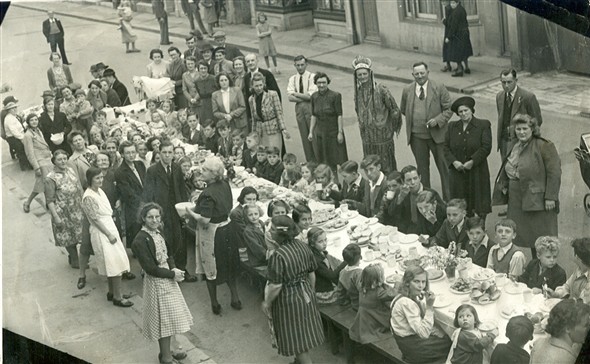
As the Queen’s Diamond Jubilee draws near people are preparing to celebrate. This year there is a whole variety of events to mark the occasion including the lighting of huge beacons right around the country. However, here in Glossop we have kept with the tradition of street parties. Surely no one can resist a party? A chance to have drink, relax and spend some time with friends and family.
The tradition of street parties as we now know as residential events that take place in their own streets seem to have taken off on a large scale in 1919. They were held in July as 'Peace Teas' as a genuine celebration of the signing of the Versailles peace treaty after the First World War. They were tea parties that were focused on a special treat for children in those times of hardship and were quite formal sit down affairs.


These residents led street parties were a popular mass participation and were probably a development of more formal public street dinners that had historically been held, such as for Queen Victoria's Diamond Jubilee in 1897. Then after the Second World War the entire county went street party mad. The craze continued with the coronation of Queen Elizabeth the Second. Street parties have been seen on many occasions since such as the Golden Jubilee and the Royal Wedding last year.

At the end of this month there will be small exhibition in the Glossop Railway Station depicting 60 years of Glossop past and present. There will also be a celebration walk on the 26th May and on the 9th June.

I am looking for photographs of Glossop street parties over the years. It would be great if we could find one from 1953 Coronation.

If you would like to share your photographs memories then please get in touch.