Showing posts with label Lord Howard. Show all posts

Thursday, 21 September 2017

Heavy Rain, Floods and Christmas

Back to normal with monthly posts yet this month is more updates. 

The last week or so has brought heavy rain and new things even I haven't seen in the town before. The weather is turning autumnal and with Christmas just around the corner my reflections always turn to Woolworths.

The store that sold everything was definitely the place to get your Christmas stock. It had a fantastic line of plastic Christmas trees and lights and going to Woolworths was a pure tradition. We lost our store in 2009 when the business closed around the country. You can read more here.

Glossop has gained a multitude of local shops and businesses over the last couple of years and as of next month we will be featuring several of them here as I make the final arrangements and filming for Glossop Tours big Christmas Special, Personal Stories. Over the last 12 months I have been working with a local film producer filming interviews with local people to feature part of an online mini documentary series and for the Christmas Special.  These not only feature local shops, businesses but local people and dignitaries. We are continuing filming right through to summer next year so if you or know of someone that you think will have something interesting to share then please get in touch.

I have also started a sister site that follows my travels around the local area, region and beyond. These include reviews of cafes and restaurants as well as history, walks and interesting hidden gems, this will go live at the event in December.

Soon you will be able to book our tours in Glossop it's self as we are looking at possibility of having a booking office in the town. There will also be a opportunity to see some of our history and possibly some of our collection from time to time.

This year has been a real roller coaster with health and work opportunities and things  are looking good for the beginning of 2018 and hopefully we will be opening up our own local office, so watch this space.

There have been fears of local flooding recently with heavy rainfall again in Glossop. Nothing has been done to create new flood defenses since the last major flooding in 2001. Again there was no inquiry into whether it was human error that caused the flooding as evidence did show Swineshaw Reservoir in 2001 as it is common by word of mouth in the town must of opened their sluice gates because there was a serious threat the reservoir was to burst, which would of caused more serious threat to the town. 


So to the Christmas Special, tickets and more details are to be released in October. It will be three evenings of history, workshops and discussions. As there has not been any event this year so far we are pouring all our efforts into this. But hang on what's new, that I have discovered recently, well a lot but if you follow us on Twitter, Instagram and Facebook we're asking you to work out where we are in the town and the most right answers will put together and a random lucky winner will get two free tickets to our Christmas Special.

Looking forward to seeing you all very soon....  By 
Matthew Cox.

Follow on Instagram
Follow on Twitter


Wednesday, 16 September 2015

Glossop Cotton Queens - From Miss Glossop to Miss England 1930


The Cotton Queens 


According to a recent survey over 18 million people attend music festivals here in the UK every year. Music, arts and film festivals are on the rise and now attracting global attention bringing in the biggest names. History festivals are now starting to crop up here and over thirty took place over the summer.

There have always been festivals in Glossop some festivals have survived the test of time and some have now faded. It was not up until recently that we celebrated the May Cotton Queens. This festival celebrated just one thing, cotton. This one day in May was dedicated to a huge, colourful parade throughout the town. It was not only to celebrate the towns industry but an advertisement! A huge competition would take place between all the mills in the valley to determine the best cotton queen. The mill owners would choose the fairest girl within their business to showcase their finest product, similar to the Miss World competitions today.

They would parade through the town on the back of rickshaws and flatbeds and later vans. Some would depict a moment in history and others would show fashion, similar to the floats we have today at carnivals. It would then be up to a panel of judges normally including the Mayor to announce and crown “Miss Glossop”.

Then later in June it would go National a massive competition to find the “Cotton Queen of England”. I have found a report in a 1930s National newspaper, a truly fascinating little piece of our history, how “Miss Glossop” got to the final.

Cotton Queen 1930 Miss Glossop to Miss England  


In May 1930 Cotton Queen Festivals took place all over the North West of the country. Glossop held one of the largest; over 60 queens were presented that year from far and wide. The competition was fierce; competitors came from Manchester, Hyde and Cheshire. The competition was won by Miss F. Lockett who came from Newton Moor Mills of Hyde, a weaver aged 20. Miss Lockett was crowned ‘Miss Glossop’ and was paraded through town and was done so with,  “full of delight and splendor” according to a local reporter.

In June following on from the regional events, the Nationals took place. As I mentioned last week, I have found a report in a National newspaper that covers the Final in 1930. The Grand final of the search for “Miss England” took place in the Tower Circus, Blackpool. A total of 40 queens made it to the final stage where they were put “on display” and asked to do a variety of task, properly just walking round!

The panel of judges cut the 40 queens down two and took time to select a winner. The two finalists were, “Miss Salford” Miss E. Knox a clerk from Ordsall Dye Works in Salford and “Miss Glossop”.

The winner was selected by the Mayoress of Blackpool and was crowned “Miss England”. The top prize was given to “Miss Glossop” and was put on the grand throne in the centre of a massive parade. According to the news article, “ over 400,000 people flocked to see the Cotton Queen of England, the storm clouds retreated and the glorious sun shone over the queen of queens and her people”.
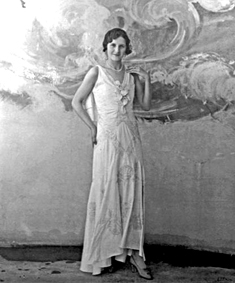
Cotton Queen Frances lockett in elegant 1930s poseMore than 20,000 people lined the streets when Frances Lockett returned to Hyde after being crowned the first Cotton Queen of Great Britain. Such was the town’s pride that she was treated like a member of the Royal Family.

Yet Frances was actually a Derbyshire girl. At the time of her success she lived, quite aptly, on Queen Street, Hyde. But she was born at a house on Gladstone Street, Glossop, and spent her infancy there.

Indeed, because of the way the competition was organised by the Daily Dispatch (a newspaper which folded in 1955 and was ultimately absorbed by the Daily Mail she won her title as Miss Glossop and Hyde.

"The final took place at the Tower Circus, Blackpool, on 28th June, 1930. Frances, wearing an ivory-coloured ball sheen gown designed in the latest Parisian style by Kendal Milne of Manchester, was described as tall, slim and pretty. She certainly made her mark on the judges – the Marquis of Donegal, Lord Inverclyde and JW Tout MP – and there was a huge roar when it was announced that Miss Glossop and Hyde had beaten the other 17 entrants.
Before the crowning ceremony, Frances changed into a gown that was 50 per cent cotton and 50 per cent satin, with red Lancashire roses forming a line from the shoulder."

The train was white-edged with ermine, caught at the neck with golden cords. The lining was golden also.

Mrs GW Gath, the Mayoress of Blackpool, placed the crown on Frances’s head. Made of gold lined with red velvet, it was set with rubies and diamonds. She also received a portable gramophone, and a silver dressing case on behalf of Blackpool Corporation. The people of Hyde were ecstatic and thousands lined the streets for the victory parade, which began at Frances’s place of employment, J and J Ashton’s Mill, off Ashton Road.

Overnight, Frances went from mill girl to celebrity. A cotton queen waltz was written in her honour and her likeness appeared on specially produced Queenella handkerchiefs. However, she was much more than a clothes horse. As articulate as she was elegant, Frances wrote and delivered speeches promoting the value of cotton produced by British workers.Drawing huge crowds wherever she went, Frances spoke at West End theatres, the British Fashion Ball at Covent Garden and British Cotton Textile Exhibition at White City.


A Clip of 1936 Cotton Queen Final can be seen here: http://www.britishpathe.com/video/cotton-queen-aka-blackpool

By Matthew Cox

Check Out Our Events & Projects at glossoptours.moonfruit.com


Monday, 23 March 2015

Glossop North End AFC - Samuel Hill-Wood

The Legends of Football - Part One - Lost Heroes, Treasured Pride by Matthew Cox

Sir Samuel Hill-Wood, born on 21 March 1872 the son of Samuel Wood and Anne Kershaw Sidebottom, lived a long and prosperous, public life.

From early childhood Samuel Hill-Wood known locally as “Sammy” showed an unbelievable understanding of his family’s cotton business and how it was constructed and managed. Inspired by his father and grandfather to continue the business he was sent to be educated at Eton College. It was here where Sammy first acquired his obsession with sport. On returning from College, Sammy was fascinated to hear that Glossop had set up their own football club (Glossop North End) and that some of his father’s employees were involved. In response he organised a team representing his fathers company named Howardtown F.C. He played alongside employees in local leagues which consisted of teams from butchers, victuallers and rival mills. As the football game grew nationally, Howardtown F.C was not enough for Sammy and he began talks with other clubs. It was around this time rumours began saying that Samuel Hill Wood wanted to “buy” a football club.

Sir Samuel Hill-Wood in 1928
In April 1888 his father, Samuel Wood died aged 69; with this Sammy inherited his fathers business at Howardtown mills, life savings and reputation. This gave him the incentive to carry out his ambition to create a high class football club. Sammy delivered his proposal to the founders of Glossop North End and it was accepted almost immediately. He hand selected a small team of men that consisted of a secretary, two trainers and a scout.  This “Scout” travelled the land observing the top teams of the time such as Manchester City and Preston North End for the perfect players. Sammy expressed in a telegram that, “money is the key “; a quote that still applies today. Sammy also pulled some strings in his cricket line of work, persuading fellow cricketers to come and play for him. By 1890 Glossop North End were playing in the North Cheshire League and things were looking good.

In the early 1800s the game of football was used as tool to encourage young men to go to church and to maintain a “team” spirit on the day of rest. However by the late 1800s the sport had developed not only into a national game but an entertaining enterprise. Samuel Hill Wood had spotted not only an opportunity for investment, but also advertisement on a national scale. When Sammy turned 22 he injected a huge sum of money into the club, big enough in fact to start paying wages and turned the club professional. 

This same year also saw Sammy make his debut in cricket playing for the Derbyshire County first team.  Glossop North End were making national headlines when they entered the Second Division of the Football league.

Sammy loved the attention he and the club were getting so much so he boosted the club yet again with another financial push. 

This gave them the edge they needed drafting in some of the best players from teams from all over the land and even overseas. Building in confidence the team began to draw in huge crowds which brought the money rolling in. This could be seen when Glossop North End played local rivals Manchester City at North Road. Just over 7,000 were in attendance to see City win in a narrow victory over Glossop of 2-1. From this one match they had taken £150.18s.4d on the turnstiles alone
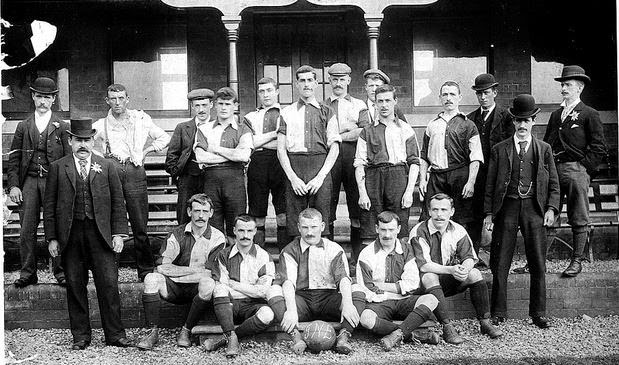
Glossop North End - The team who won promotion in 1899
.
There was a huge uproar not just nationally but worldwide when Glossop North End made it into top flight football. In 1899 the nation stared in disbelief that a small town deep within the hills were battling it out on the pitch with some of the nation’s top teams from some of the wealthy cities. This could not have been possible without Samuel Hill Woods astounding insight, a true pioneer of sport. Sammy continued to work closely with the club even taking them to a F.A Cup Quarter Final in 1909.

In 1910 Sammy began a new career as a conservative MP for the High Peak. In 1913 he was involved in top secret government plans and had an early insight of what would unfold to be the Great War. So with that in hand he returned to Glossop and began to sell his shares in the club. But the influences of Sammy remained in Glossop as the "Hillmen” or “Wood’s Men” began their battle in the F.A Cup 1913. Even with Sammy gone from the club, the reputation remained as a record of 10,736 people flocked to see Preston North End at North Road for the F.A Cup 2nd Round game.

Throughout the years to this day the legend of Sir Samuel Hill-Wood remains. As we celebrate entering the Final at Wembley of the FA Vase, the “Hillsmen” are a distinct reminder of that great pioneer. Just think Sammy had his own football club at the age of 18 and in the space of 14 years his club, Glossop was and still is to this day the smallest town in England ever to have a team grace the top flight football league.

By Matthew Cox 

Follow me on Twitter: @Matthew_R_Cox    or    @ GlossopTours  for more updates about this historic club.


Friday, 13 February 2015

A History of Dinting Station


A History of Glossop Railway Line & Beyond..


Part 3 of 6 - Dinting Station - "Rich Past, Present & Future"

The first train to arrive at Dinting Station was on 24th December 1842. In the early days of travel the line from Manchester to Sheffield terminated at Dinting, however, in those days the station was in fact called Glossop. Then the traveller would then have to board a coach and horses for the remainder of the way which made the total travel time about 5 hours.


On the 9th June 1845 the one mile branch to Glossop opened for 
goods traffic but because it was built by the 13th Duke of Norfolk it did not have to obtain an Act of Parliament. The former “Glossop” station became known as Dinting. The first station was a wooden structure until it was replaced by a permanent building in 1847. Another outer building was created and was known at “Glossop Junction” as well as an ornate engine shed. A coaling stage was created and a series of goods yards and shunting bays leading to Mottram Yard.

On 18th September 1855 a train stopped short of the platform. Not realising that they were still on the viaduct three passengers left the train and fell to their deaths.
In 1884 new facilities were built on the triangular junction they included ample accommodation, the Station Masters house, first and second class waiting rooms and even a home for the Permanent Way Inspector.  


Dinting Station was given a new lease of life in 1967 in the form of The Bahamas Locomotive Society a working steam engine museum that attracted thousands of people. The museum also attracted world famous engines such as the Blue Peter and Mallard. The Museum out grew Dinting and move to Yorkshire in 1991.


A couple of years ago Friends of Dinting Station was created to preserve and maintain Dinting Railway Station’s rich past.


By Matthew Cox


A History of Glossop, Manchester & The Woodhead Railway Line


Thursday, 29 January 2015

A History of Glossop Railway Line & Beyond...

A History of Glossop, Manchester & The Woodhead Railway Line


Part 2 of 6 - Glossop -"The Link to Foreign Lands"

The Glossop branch was built by the 13th Duke of Norfolk when the historic Manchester to Sheffield line bypassed the town in 1845. The Duke gave his land and paid all the expenses for the one mile extension from Dinting Vale to Glossop. The initial station was complete with a private waiting room with a fire place and a small room for the station master, porters and other staff. Glossop station was initially for the sole use of the Duke of Norfolk when he resided during the summer months at his manor house, Glossop Hall. 


Glossop Central opened for goods traffic on 9th June passenger traffic began on 30th June 1845.

Glossop station provided a direct link to the outside world, as there was only one stage coach that ventured out of the town a week to Manchester and Sheffield before the railway was built. The Duke welcomed new shipments of coal, slate & wood. He saw the potential for growth and commissioned a goods depot and yard adjacent to Glossop Central in 1847. The goods yard was complete with the Lord Howards Lion, which still stands to this day, a reminder the Duke freely gave his land and money.

The railway was responsible for the rapid growth of the town, throughout the late 1800s. Over 50 mills scattered the valley dependant on a variety of shipments such as cotton from America and timber from Scandinavia.  The Duke of Norfolk sold the line and gained double profit to what would become the Great Central Railway.

The station was renamed on 10th July 1922 as Glossop Central.

Glossop Central expanded the passenger section of the station opening a booking office in 1847 and a waiting room for the 1st and 2nd Classes. The station also had refurbishments in 1912 when the iron stanchions were put up that still exist today. As the town began to thrive a second passenger platform was built.

The railway transported local troops during the two world wars which proved to be a great asset as some of the Glossop men were in the first wave of the Dunkirk landings. They also brought evacuees from Lowestoft to safety in Glossop

During the early 1940’s Glossop, along with the rest of the Manchester and Sheffield via Woodhead line, were making preparations for electrification but was halted due to the 2nd World War.  The line was the first all-electric line in Britain with the first electric train arriving in 1954. The station was refurbished to meet the needs of the new trains but resulted in the closer of the waiting rooms.

In the 1980s the goods yard was closed then in 1982  the second platform closed.

In 2002 Friends of Glossop Station (FOGS) were set up and set upon saving and preserving the historic station. They were responsible for new improvements including new skylights reopening and renovation of the waiting rooms and a new booking office in 2011. 

Monday, 14 May 2012

Glossop Street Parties


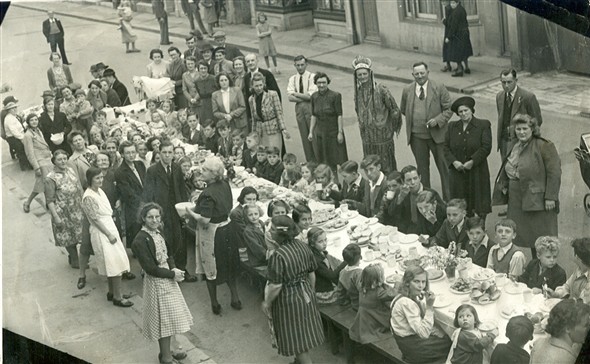
As the Queen’s Diamond Jubilee draws near people are preparing to celebrate. This year there is a whole variety of events to mark the occasion including the lighting of huge beacons right around the country. However, here in Glossop we have kept with the tradition of street parties. Surely no one can resist a party? A chance to have drink, relax and spend some time with friends and family.
The tradition of street parties as we now know as residential events that take place in their own streets seem to have taken off on a large scale in 1919. They were held in July as 'Peace Teas' as a genuine celebration of the signing of the Versailles peace treaty after the First World War. They were tea parties that were focused on a special treat for children in those times of hardship and were quite formal sit down affairs.


These residents led street parties were a popular mass participation and were probably a development of more formal public street dinners that had historically been held, such as for Queen Victoria's Diamond Jubilee in 1897. Then after the Second World War the entire county went street party mad. The craze continued with the coronation of Queen Elizabeth the Second. Street parties have been seen on many occasions since such as the Golden Jubilee and the Royal Wedding last year.

At the end of this month there will be small exhibition in the Glossop Railway Station depicting 60 years of Glossop past and present. There will also be a celebration walk on the 26th May and on the 9th June.

I am looking for photographs of Glossop street parties over the years. It would be great if we could find one from 1953 Coronation.

If you would like to share your photographs memories then please get in touch.