Showing posts with label glossop. Show all posts

Friday, 6 May 2022

Homeward Bound: Bringing Glossop's History Home

Hello, it's been a while.  Thank you for being here. Being back in physical archives, collections and long lost boxes of stuff seems better than ever. It feels like stories are pouring out of every corner and I am making  new discoveries on a daily basis. I have so many  projects to complete and lots to share. The last two years, however, have allowed me to venture far and wide, dipping my toe into collections and archives from around the world. Yet nothing beats finding something and getting up close and personal with it.

I now have access to over 300 items that have all got association with our town. These come from an array of locations from all over and during the last 8 weeks I have carefully coordinated and negotiated the release of these such items. My plan is to return them to Glossop for a set period of time. This would allow locals and visitors to see some of our lost artifacts, discover their stories attached to them and you get to see my life's work coming into fruition once again.

Where have I been? I have been working hard on bringing history to life through social history. I have continued my work throughout the pandemic and extended my sessions, presentations and experiences to people all over the High Peak as part of a project to combat loneliness, online sessions for schools, in and out of care settings and using the power of reminiscence to people in our community who suffer from dementia. I am very proud of the success I have had and even kindly received awards for my unique experiences. I have lots of great opportunities ahead to explore further. 


I am now opening back up to the wider community but I don't expect to pick up where I left off. During the early part of 2020 right up to two days before lockdown I had 4 sessions where I had just over 500 visitors, locals, schools and partners joined me for presentations and experiences. I hope to gradually grow to that potential again but as always I want to improve how to deliver things. One of the major downfalls is I can't seem to find anywhere suitable to build a ground floor space to call 'home'. Over the past 6 years I have even had full support from businesses and private backers to provide a full 2 years of rent to enable me to build the foundations but to no avail. All I need is some space. So I have to think outside the box again as I cannot wait around as there is so much for you to see, feel, do and discover. 
I have been returning to the archives both in a personal and national capacity. From cool cupboards to vast catacombs of interlocking vaults that emanate a real  Da Vinci Code vibe! So I have found some real gems during lockdown and now to not only see some of them in person but to grant the door to be wedged open to allow their birthplace to see them is monumental. This is just what I have aimed for my entire working career and passion to achieve. There is a world of items that haven't seen the light of day, some more than half a century and some have never been in the public eye. I am planning to show some of these items over my next series of talks and presentations, starting with 'Glossop's Fading Footprint'  and 'Stepping into History' . As soon as I can find suitable premises I now have permission from 6 archives to loan items to go on show. 

What is there to see? There is a wide range of items from documents, images, buttons, badges to paintings, personal accounts, patterns, cotton, grand chests and even a silver casket! There are remains of a ship that was contracted by the Woods family, that would ship cotton which I stumbled across in a shed when I was on holiday! All the items have a personal link to the town. There are even some items of great historical importance like a personal letter from the Duke of Norfolk while he was residing at Glossop during the summer. That's right the Norfolks spent time in the summer here! The letter is over 160 years old and mentions grand parties and new roles for the servants. More importantly it reveals the true position and freedom of Thomas Ellison. There is a diary linking Glossop and a visit from William Wordsworth. Personal items from Edward Fitzalan-Howard, 1st Baron Howard of Glossop. The list is growing daily and I hope that I can shed light on them for you too in the not so distant future.


Before I go, there is a bear on the hill! Sounds like a children's book doesn't it? But there really is a brown bear right here in Glossop. Why? Well I am just about to write his story as requested. So hold tight for more soon. But unlike my other artifacts, he is still here in his home from home surroundings. 

Sorry it has been so long but health has tried to get in my way but resilient as always I pledge my life to the town. I have strong and deep roots in Glossop but I'll  continue to open up the past though new innovative ways and means to allow you to step inside, to get a unique glance at the past!

Thank you for your time,

Kind Regards Matthew.  

Want to know more? Get in touch, involved or know of some space I can use or rent? 

Let me know at glossop6@googlemail.com 

Wednesday, 18 March 2020

A Moment in Time

Living In The Moment

We are all living in a unprecedented moment in time. We are living in a historic moment, where I hope we can pull together as a community, town, city or country.

Today marks the 55th anniversary of humans walking in space. 

We have shut down our main bread and butter of tours and public talks but this isn't stopping us from sharing our rich history along with improving our wellbeing, mental health and learning from behind closed doors.

We aim to achieve this in the coming days and weeks by voice, videos and posts that include, history, games, quizzes and lots of other possibilities.

We are going to look into the archives and share with you our findings of over a decade of research, discoveries and looking into private collections.

So share the links with family, friends  and loved ones. Read, comment and let us know your questions and what you might want to see next.

I never met any of my grandfathers but they have been my inspiration and fuel to do the things I do. One of I don’t talk much about simply because I don’t know much about him but in recent family chats it came to light that a hobby was to colour photographs in the 1960s. He would do them by hand with dyes and inks he would use them meticulously, precisely dropping ink to certain areas and bring a photograph to life. I will be sharing more of his hobby and him in general in a future post but its so easy to do them in an app or Photoshop these days but im going to have a go myself and have been playing around in a particular program to get an idea of  what I mean. You can see some of my efforts with this picture of the Old Cross, in Old Glossop around after 1912 marking the end of the original town centre, Howardtown became the new Glossop - Officially naming Old Glossop 'Old'.

I am looking forward to sharing my knowledge, findings as well as the mysteries and secrets our town has to offer.

Take care. Keep Safe and Speak Soon.

Don't forget to share with others, family and friends!

M.C

Monday, 24 July 2017

Glossop Tours Update 2017

Hello to readers old and new I thought it was about time to give you an update of what is happening with me and Glossop Tours and plans for the coming months. I have not forgotten you or about this blog.

I have not posted anything here for over 12 months and it has just gone so fast. I really don’t know where it has gone and so much has happened in the past year. In that time I have had over 20,000 more readers topping over 50,000 in all which is more than I have ever thought. This blog was the stepping stones of my epic journey and I will be posting again very soon.

Over the past 12 months so much has happened yet I still have not to come to terms of losing my main inspiration three years ago. I am only realising the vast about of respect, knowledge and understanding of local cultures, community and history I was taught for over 12 years.

September last year held new possibilities for me I was given a new job using my local knowledge and links to work with people with Dementia and Alzheimer’s with that is opened up the opportunity to do more with Glossop Tours. In February this year I had to have evasive surgery after funding lumps that were classified as suspicious cancerous tissue  that left me out of action for a couple of months.

In the last few months I was approached by a production group to take vlogs of the travels I have been doing to various places around the area and beyond. It proved rather successful and I am going to carry out another series as from the end of September but linking it in with Glossop tours.

In recent weeks I have been offered space in Glossop to have weekends and evening of events and to do history talks.

With everything moving on I haven’t had time to think yet I will be moving house in a few weeks and getting married next year.

Glossop has always been my first love and always will be and will be back sharing more interesting and intriguing stories about the town and local area.

There are new updates at glossoptours.co.uk

And I will see you all very soon, thank you for reading. Matthew Cox  

Tuesday, 19 April 2016

Glossop 1912

We are continuing into 1912....

At the heart of some of the world’s most devastating events, shocking incidents and even the greatest achievements, are the people from Glossop in the year of 1912. Over the coming weeks I will reveal a whole host of staggering facts, stories, eyewitness accounts, and sporting achievements that took place over one hundred years ago.


I would like to first turn to one of the oldest parts of the original village of Glossop. The stone shaft that makes up the main frame of the Old Cross has stood the test of time. It thought to have been placed here around 1157 when the parish of Glossop was granted to hold a court, a fair and a market around the stone cross. Over the centuries it became custom to announce the new kings and queens and other important messages from the cross, after all it was the centre of the town. It was not until the early 1800s when the cotton industry began to develop further down the river when plans were put in place to pursue a new town centre. It was when the new complex at Howardtown was built in 1838 when things really began to change. Over the next few years it was clear the offices and court room along with the fast development of the new cotton mills, Howardtown, by far superseded the original part of the town. Glossop was granted a borough in 1866 and people began to regard Howardtown as the centre of Glossop.

In 1910 it was moved to where it stands today
The Old Cross never bore the Celtic stone cap to begin with. 1910 saw the reign of George V which was announced at the cross like the many Monarchs before him. The officials of the Borough of Glossop wanted to place a cap on the stone cross not only to mark the coronation of the king but to symbolise the unity of faiths. The cross was moved from its previous position as it was tight against the house behind, to where it stands today. The Celtic cross was finally placed on top of the ancient cross in 1912.


The Old Cross in Old Glossop

Tuesday, 2 February 2016

Glossop Connections - Charles Calvert, Raisley Calvert & William Wordsworth

Glossop Famous Connections
The Calvert Family - A Celebrated Artist. Charles Calvert Junior.

In my last post I had mentioned that Charles's first son, was Frederick Baltimore Calvert but it is in fact it was his second. I have managed to trace that Charles had in fact eight children. His first child was also born at Glossop Hall and was named after his father on 23rd September 1785. Records show that Charles Calvert Junior was taught at the hall itself in Glossop, Derbyshire. He became an apprentice to his father within the family cotton business. He seems to become a very successful cotton merchant until, however, he abandoned cotton for art and became a landscape painter.

His influences for this drastic change of mind came from his uncle, Raisley Calvert who was a renowned sculptor. Raisley Calvert, was in fact, the Steward to the Duke of Norfolk, and looked after his estates at Greystoke. Raisley not only had a great career but great connections as he was a close friend and admirer of William Wordsworth. They were at Cambridge University together where they became very good friends, this is their story...

William & Raisley 
William Wordsworth
William was sent to school at Hawkshead where he made friends with a boy from Cockermouth called William Wordsworth. The two boys were the same age and from similar backgrounds. Wordsworth’s father was an agent for Sir John Lowther, the Earl of Lonsdale. When they left school Wordsworth went to Cambridge, travelled abroad and lived for a while in London while William joine
d the Duke of Norfolk’s Regiment (then known as the 12th Regiment of Foot) of the Militia. In 1791 William’s father died, and he and Raisley inherited a sizeable fortune.
In July 1793 William Calvert invited Wordsworth to accompany him on a tour of the West Country, all expenses paid. Wordsworth wanted to become a poet but had no job and no income. He eagerly accepted William’s offer and the two young men set off. They spent about a month on the Isle of Wight where they watched the English fleet preparing for the war with France. They then headed west, but near Salisbury their horse dragged the carriage in which they were travelling into a ditch and it broke into pieces. The two men decided to separate. William took the horse and rode home to Keswick while Wordsworth set off on foot and walked across Salisbury Plain. He travelled through very bad weather, rested at Stonehenge and had some visions: an experience which led to the writing of his poem ‘Salisbury Plain’. Later that year he visited William and his brother Raisley at their family farm at Windy Brow on the slopes of Latrigg near Keswick. 
In early April of the following year William invited Wordsworth and his sister, Dorothy, to stay at Windy Brow. Wordsworth and Dorothy were delighted. They had been separated since childhood. After the death of their mother in 1778 Dorothy had been sent away to live with relatives. They had met up again in Halifax for six weeks but now they looked forward to a holiday together. They travelled by coach to Kendal then walked the eighteen miles to Grasmere and a further fifteen miles to Keswick. William Calvert was away with his regiment but Wordsworth and Dorothy stayed with his tenants at the Windy Brow farmhouse (Right). Dorothy loved staying at Windy Brow. She wrote to her friend, Jane Pollard, saying how delighted she was with the situation of the house.
She described, in glowing terms, the view from her window which looked out over the River Greta, Keswick town and Derwent water. She described how cheaply she and her brother could live, with milk for breakfast and supper and mainly potatoes for dinner. There was a terrace path on the slopes of Latrigg, above the house, where Dorothy enjoyed walking and admiring the view of the vale of Keswick . They spent a month at Windy Brow and it was during this time that Dorothy first started to copy out Wordsworth’s poems: a job which she would continue to do for the rest of her active life. 
Later in 1794 Wordsworth returned to Windy Brow to find that William’s brother, Raisley, was very ill with consumption. William was with his regiment in Tynemouth, Northumberland. Wordsworth suggested that he might accompany Raisley on a visit to Portugal to improve his health if William would cover the costs. At the same time Raisley decided to write a will. He left everything to his brother except for a £600 legacy (later increased to £900) to Wordsworth. Wordsworth wrote to William asking for money for the trip to Portugal. William responded immediately and offered to pay all costs. Wordsworth and Raisley set off but they only got as far as Penrith and had to turn back the next day because Raisley was worse. Wordsworth stayed to nurse Raisley at Windy Brow but Raisley died in January 1795. Raisley’s legacy was a valuable asset for Wordsworth at this time.

There are records to show the visited family and went to a "hunting lodge" which is strong evidence that they visited Glossop at this time. During the early periods of Glossop Hall it was used as a holiday home and a hunting lodge. it is just wonderful to think that this great man made his presents in Glossop itself.

This friendship was so strong that William Wordsworth visited Raisley on his deathbed and personally cared for him right up until his death in 1794. Unknown to William, Raisley had left him a legacy of nine hundred pounds, a small fortune of the day, as a mark of gratitude. William never forgot this as he wrote later:

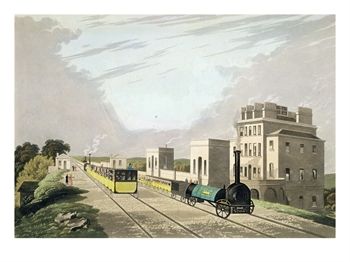
 Manchester and Liverpool Railway in 1825 by Charles Calvert


"Calvert! It must not be unheard by them
Who may respect my name, that I to thee
Owed many years of early liberty.
This care was thine when sickness did condemn
Thy youth to hopeless wasting, root and stem."


Charles Calvert Junior became a great landscape painter and teacher of art. One of his most famous paintings was of the Manchester and Liverpool Railway in 1825. He was one of the founders of the Manchester Royal Institution now the Manchester City Art Gallery. He gained the Heywood gold medal for a landscape in oil, and the Heywood silver medal for a landscape in watercolour. He loved to spend his spare time in the Lake District. When he died he was buried at Bowness-on-Windermere.

Compiled By Matthew Cox

In Addition:

William Wordsworth died in 1850. A few years later the Greta Bank estate was sold to Mr Anthony Spedding. The house at Greta Bank was substantially rebuilt and has now been converted into apartments known as ‘Brundholme Country Houses’. Calvert’s Bridge has given its name to the nearby ‘Keswick Bridge’ Timeshare Lodges. In 1978 John Fryer Spedding set up the Calvert Trust to provide outdoor adventure activities for people with disabilities. The name was chosen in memory of Wordsworth’s benefactor, Raisley Calvert, ‘to represent friendship, support and the desire to help somebody to fulfill their potential’. The Windy Brow Farm where Wordsworth nursed Raisley is now owned by the Trust. Calvert was an interesting character. He had some influence on the Lake Poets, he took a keen interest in agricultural development and he was a kind and generous friend to those around him.

More Information & Sources

Calvert, Charles (1785–1852), landscape painter, born at Glossop Hall, Derbyshire, on 23 September 1785, was the eldest son of Charles Calvert (1754–1797), land agent, and his wife, Elizabeth Holliday (1751/2–1842). His father was agent of the duke of Norfolk's estate in Derbyshire and an amateur artist. Charles Calvert senior died on 13 June 1797 and was buried in St Mary's churchyard, Manchester. Calvert began business as a cotton merchant in Manchester, having been apprenticed to the cotton trade, but abandoned commerce for art and became a landscape painter. He was instrumental in the foundation of the Manchester Royal Institution (which later became Manchester City Art Gallery) and gained the Heywood gold medal (awarded to local artists) for a landscape in oil, and the Heywood silver medal for a landscape in watercolour. The Manchester Courier reported in 1828 that, of local artists, Calvert's paintings were the most consistently sold. He was not well known outside his region, however, and exhibited only two works in London, one of which, at the British Institution in 1825, was entitled Near Rustom, Cheshire.

Calvert devoted much of his time to teaching, and spent the remainder painting in the Lake District. Although confined to his bed in later years, he continued to paint landscapes from memory. He died at Bowness, Westmorland, on 26 February 1852, and was buried there. Examples of his work are in the Victoria and Albert Museum, London, and Manchester City Galleries.

Charles Calvert's brothers included , actor and lecturer on elocution, , surgeon, Henry Calvert (1785–c.1869), sporting and animal painter, and Michael Pease Calvert, painter. He was father-in-law to the portrait painter .

In the Dictionary of National Biography Raisley Calvert (bap. 1773, d. 1795), friend and benefactor of William Wordsworth, is incorrectly described as Charles Calvert's younger brother. Raisley Calvert was baptized on 16 September 1773, the younger son of Raisley Calvert senior (1728/9–1791), steward of the duke of Norfolk's estate at Greystoke Castle, near Penrith, Cumberland. His elder brother was William Calvert (1771–1829), who was at school with Wordsworth at Hawkshead, Lancashire, where he later became schoolmaster. On the death of his father, William Calvert became a man of independent means, inheriting, with other property, the estate of Bowness on the east shore of Bassenthwaite, near Keswick. Raisley Calvert inherited from his father several farms near Keswick, the income from which was held in trust until he attained his majority in 1794. He was admitted to Magdalene College, Cambridge, on 14 February 1793, where he became friends with Wordsworth, but left soon afterwards with a resolve to educate himself by travel on the continent. Though described in the Dictionary of National Biography as a sculptor, no evidence has come to light of any works sculpted by Raisley Calvert. On falling ill with consumption, he returned to the Lake District, where he died at Penrith after 7 January 1795, when Dorothy Wordsworth mentioned that he was ‘barely alive’ (Letters of William and Dorothy Wordsworth, 139). He was buried on 12 January. In his will, signed on 23 October 1794, Raisley Calvert left £900 to Wordsworth. The poet subsequently wrote a sonnet, ‘To the Memory of Raisley Calvert’, and later mentioned him in lines 349–67 of the thirteenth book of The Prelude:
A Youth (he bore
The name of Calvert.
(lines 349–50)


Sources  

W. E. A. Axon, rev. L. R. Houliston, Art Journal, 14 (1852), 150 · S. Urbans, GM, 2nd ser., 37 (1852), 630 · T. Fawcett, The rise of English provincial art: artist, patron and institution outside London, 1800–1830 (1974) · G. Meissner, ed., Allgemeines Künstlerlexikon: die bildenden Künstler aller Zeiten und Völker, [new edn, 34 vols.] (Leipzig and Munich, 1983–) · M. Hall, The artists of Cumbria (1979) · D. Child, Painters in the northern counties of England and Wales (1994) · Bryan, Painters (1903–5) · Redgrave, Artists · Mallalieu,Watercolour artists · M. H. Grant, A chronological history of the old English landscape painters, rev. edn, 8 vols. (1957–61) · IGI · H. M. Cundall, A history of British water colour painting (1908), 193 · The letters of William and Dorothy Wordsworth, ed. E. De Selincourt, 2nd edn, rev. C. L. Shaver, M. Moorman, and A. G. Hill, 8 vols. (1967–93), vol. 2, pp. 81, 97, 126n., 139–40 · W. Wordsworth, Poems, in two volumes, and other poems, 1800–1807, ed. J. Curtis (1983), 151–2

Sunday, 6 December 2015

Woolworth's at Glossop 1941 to 2009


Winter Woollies

“It’s beginning to look a lot like Christmas”. There is definitely a chill in the air as the festive season sneaks in to town.  There was a feast of traditional sights and smells that were sampled by many at the Glossop Christmas switch on, last Saturday evening. The celebration kick started the late night shopping throughout the town and market, for all your gifts, goodies and treats.  It was at that moment I reflected about our more recent history.

In 1941 the drapers at 9 High Street West was bought by the American company that was spreading the country by storm. That company was F. W. Woolworths. It opened its doors later that year and offered a wide range of wares. It was to become one of Glossop’s first self-service stores. Previously you would have given your shopping list to the shopkeeper in order for them to find the goods for you.
The first Woolworths store to open in America was back in 1879 then in 1909 the first British store opened in Liverpool with a huge celebration with a full orchestra, circus and firework display. It was then in 1910 that Frank Woolworth commissioned the design and construction of the famous Woolworth building in New York.
Back in Glossop the store was vital throughout the war years, providing a wide variety of goods that were available all in one place.  It was an early example of the modern supermarket. The store expanded over the years taking up three shop spaces. The original sign over the door read “Woolworths. F. W Bazaar” and was set in gold and black very similar to the Finlay McKinlay’s sign next door.  The name changed over the years as it became a British company. This resulted in the famous red sign we all knew and loved.
Woolworth's lasted 68 years in Glossop as it closed its doors in 2009. During its closing down sales it sold everything right down to the fixtures and fittings.
Woolworth's was a local favourite and a national icon but will you miss it this Christmas?

By Matthew Cox

Tuesday, 16 June 2015

A Brief History of The Oakwood, Glossop


The Oakwood public house sits proudly on the corner of High Street West and George Street in Glossop. There has been a building on this site since 1844. The original inn was owned by George Pye and remained in his family till 1875, when it was sold to John Gardener Sykes who had it demolished.  The original Public House was named The Surrey Arms, in connection to the Lord Howard’s family relations. However, it was know locally as “The Big Surrey” to distinguish between the other Surrey pub on Victoria Street. Mr Sykes made plans to build a guest house or hotel on the site.
The building work began on the plans to build a “Grand Style” hotel in 1878. In local papers in November in the same year is said that “A large and handsome hotel to the cost of £6000 is to be erected on the site of the present Surrey Arms with work in progress”. The building had many rooms for guests as well as a hall and billiard rooms upstairs. It possessed a spire with a flag pole that was eventually removed in the 1940s but can be seen on the 1910 tram footage of Glossop featured on the Times Past DVD from the Glossop Heritage Trust.
Eventually in 1901 it was bought by Robinsons Brewery and it remains with the same brewery to this day.  It had a major renovation in 1991 where it uncovered the original oak panelling on the first floor. Robinsons renamed the pub The Oakwood in relation to their findings. In more recent times it has undergone more renovations, however it still possess the fantastic glass windows that advertise the billiard rooms and Burton Mild and Bitter Ales. It also has a castle carved into its stonework but can you find it?
The Oakwood still uses the hall upstairs for music, concerts and theatre performances. So next time you are in town, take a look for yourself at Glossopdale’s fantastic history.
A huge overhaul has just taken place bringing the public house right up to date but with plenty of historic charm. A big highlight of the High Street today.


Matthew Cox

Monday, 15 June 2015

Olive and Partington Paper Mills, Glossop

The Hidden Gems of Glossop and the High Peak
A brief look at Olive & Partington Paper Mills, Glossop

Glossop was once famous for producing endless miles of cotton products but it is often overlooked that the town produced some of the finest paper in the world. Its produce was used by some of the world leading brands and companies.
The Turnlee Mill stood on Charlestown Road, Glossop. It was bought by Edward Partington and his business partner William Olive around 1874 from Thomas Hamer Ibbotson. Edward Partington brought his flourishing business from Manchester to Glossop only to develop further. The paper mills at Glossop gradually incorporated several other smaller mills such as Tip Mill and Burymewick Mill in order to try and develop the modern method of paper manufacturing using the sulphite process.
The sulphur was brought by the railway to the goods yard in large barrels along with the vast quantities of logs. These were then loaded, by hand, onto the horse pulled flatbeds and trailers which were replaced later in 1917 by the famous fleet of Tiger tractors. Some locals still remember the huge steam tractors hauling many tons of logs and sulphur from the Railway Station up Victoria Street onto Charlestown Road, towards the Turnlee Mills.
One of the 'Tiger' Tractors (No.3) still remains today having been fully renovated by a group of enthusiasts and currently lives in New Mills and visits many national steam events throughout the year 
Guinness, Cadbury's & Women Magazine are just a few from the extensive list of companies that used the paper produced in Glossop. The mill provided over 1,000 jobs and offered “All the year round vacancies”- a slogan of the bygone era.
Disaster struck on 25th June 1943 as one of the spherical boiling pans, weighing six tons and spanning twelve feet in diameter, exploded killing four men. There were numerous other injuries including burns from the boiling sulphur solution.  The steam Tiger traction engines were used to clear the debris. The appalling stench of the sulphur gases were reported all over the town.
Very little exists of the Olive and Partington Paper manufacturers at Turnlee Mills as many of the buildings have been demolished. You can still see some of the grand architecture such as the main gate stones and walls that still survive.
Today on the site, there are are a few small businesses flourishing from the ashes of what was one of Glossop’s greatest assets. The rest has recently been demolished to make way for a new housing estate but one corner of the original building has been saved and been converted into apartments. It is yet another gem of Glossop Dale that should never be forgotten.


Matthew Cox

Glossop Tours on Twitter

Thursday, 7 May 2015

A Snapshot of Glossop North End's History

  Glossop North End Nets 10 -1 in Four Days

As Glossop North End enters its last preparations for the FA Vase Final vs North Shields to be played at Wembley on Saturday 9th May, I have taken some time in the archives to show some of the forgotten magic of GNE.

The following pieces are taken from a study I was involved in during the preparations Glossop North End's 125th Anniversary. 


In 1899 Glossop North End were fighting for promotion and as they entered the new year a string of wins were waiting for them.


“Glossop journeyed to Darwen in order to meet for the first time the wooden spoonists of the Second Division … without Gallacher and Colvin, the vacancies being filled by Sutcliffe and Sidebottom, the latter a promising reserve player.
Game a very interesting one … the Glossopians did their duty well. The wooden spoonists have two capable backs, whilst Lumsden found some strong opponents on his side of the field. I don’t think I have seem Williams save more effectively, whilst the forwards, although weakened by the absence of Gallacher and Colvin, played most creditably, Donaldson showing a real liking for the company of Whittaker, the Darwen goalkeeper. Sidebottom was brought into the team, and I must say he is the best of the locals – barring Sutcliffe … that have been tried this season.
Glossop North End - The End of Season 1898/99 
McEwen was partnered by Killean for the first part of the game, Rothwell changing places with the latter after an hour’s play. The captain by no means shaped badly in the front rank … personally I like to see him in the rear … he hasn’t quite enough greyhound for a forward. The halves were all right. The two great events of the week have been the severance of Pryce’s connection with the North End club and the suspension of Clifford for a fortnight.” Glossop-Dale Chronicle 3rd March 1899.

Glossop Football Card 1900


“Glossop North End have had a really good week, netting four points in the English League, and improving their goal average to the tune of ten goals to one … fourth in the table. The question seems to arise one more as to whether the team will reach a point sufficiently high in the table to ensure their entrance into the charmed circle of the First Division. It seems to one that Manchester City and Leicester Fosse have the best chance, and Glossop North End and Burslem will be the most dangerous opponents of the Midlanders.
The Gainsborough men gave the North Enders a good game in the first half, only two goals being scored, and the football in the second moiety was spoiled by the heavy downfall of snow. The Trinitarians tried hard, but they were no match at all for the Glossopians … The Glossop goalkeeper is to be complemented on the manner in which he saved the penalty kick … he advanced and turned the shot for a corner after it had scarcely left the kicker’s foot. McEwen was the better back, and the halves and forwards were all on their best behaviour, with the exception of Colvin, who was evidently suffering from the effects of his recent injuries, and was off form altogether.
On Tuesday the unfortunate Darwen team visited Glossop. Goalkeeper Whittaker failed to turn up and Woolfall took his place … The game was uninteresting … the visitors were only dangerous on three or four occasions ... Colvin was in better trim, and every man played well, though they let their opponents down more lightly than they might have done.”
Glossop-Dale Chronicle 10th March 1899.


Many thanks again to the club & members for permission to use this content. Copyright Belongs to Glossop North End AFC. 


Complied by Matthew Cox - I wish all the club, players management & officials a huge congratulations on their achievements already this season by winning the double of the league & the league cup & the very best for Saturday. VIVA GNE! - It is in no doubt that this season is the best and I mean the very best in living history. To be a part of it was hugely exciting both as a supporter, fan and historian alike. 

From the words of my Dad "Win or Lose Have A Booze!" - FA Vase Final 2009

You can find me on Twitter @Matthew_R_Cox or @GlossopTours


Monday, 23 March 2015

Glossop North End AFC - Samuel Hill-Wood

The Legends of Football - Part One - Lost Heroes, Treasured Pride by Matthew Cox

Sir Samuel Hill-Wood, born on 21 March 1872 the son of Samuel Wood and Anne Kershaw Sidebottom, lived a long and prosperous, public life.

From early childhood Samuel Hill-Wood known locally as “Sammy” showed an unbelievable understanding of his family’s cotton business and how it was constructed and managed. Inspired by his father and grandfather to continue the business he was sent to be educated at Eton College. It was here where Sammy first acquired his obsession with sport. On returning from College, Sammy was fascinated to hear that Glossop had set up their own football club (Glossop North End) and that some of his father’s employees were involved. In response he organised a team representing his fathers company named Howardtown F.C. He played alongside employees in local leagues which consisted of teams from butchers, victuallers and rival mills. As the football game grew nationally, Howardtown F.C was not enough for Sammy and he began talks with other clubs. It was around this time rumours began saying that Samuel Hill Wood wanted to “buy” a football club.

Sir Samuel Hill-Wood in 1928
In April 1888 his father, Samuel Wood died aged 69; with this Sammy inherited his fathers business at Howardtown mills, life savings and reputation. This gave him the incentive to carry out his ambition to create a high class football club. Sammy delivered his proposal to the founders of Glossop North End and it was accepted almost immediately. He hand selected a small team of men that consisted of a secretary, two trainers and a scout.  This “Scout” travelled the land observing the top teams of the time such as Manchester City and Preston North End for the perfect players. Sammy expressed in a telegram that, “money is the key “; a quote that still applies today. Sammy also pulled some strings in his cricket line of work, persuading fellow cricketers to come and play for him. By 1890 Glossop North End were playing in the North Cheshire League and things were looking good.

In the early 1800s the game of football was used as tool to encourage young men to go to church and to maintain a “team” spirit on the day of rest. However by the late 1800s the sport had developed not only into a national game but an entertaining enterprise. Samuel Hill Wood had spotted not only an opportunity for investment, but also advertisement on a national scale. When Sammy turned 22 he injected a huge sum of money into the club, big enough in fact to start paying wages and turned the club professional. 

This same year also saw Sammy make his debut in cricket playing for the Derbyshire County first team.  Glossop North End were making national headlines when they entered the Second Division of the Football league.

Sammy loved the attention he and the club were getting so much so he boosted the club yet again with another financial push. 

This gave them the edge they needed drafting in some of the best players from teams from all over the land and even overseas. Building in confidence the team began to draw in huge crowds which brought the money rolling in. This could be seen when Glossop North End played local rivals Manchester City at North Road. Just over 7,000 were in attendance to see City win in a narrow victory over Glossop of 2-1. From this one match they had taken £150.18s.4d on the turnstiles alone
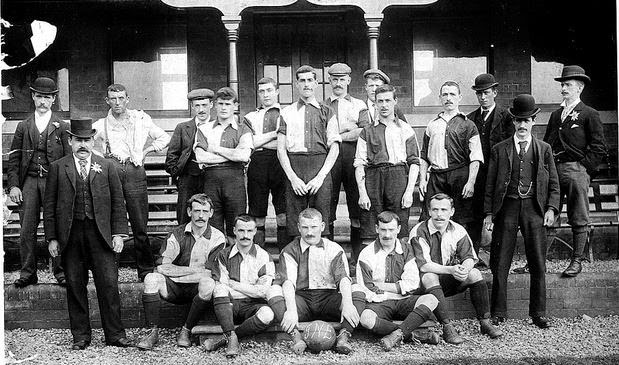
Glossop North End - The team who won promotion in 1899
.
There was a huge uproar not just nationally but worldwide when Glossop North End made it into top flight football. In 1899 the nation stared in disbelief that a small town deep within the hills were battling it out on the pitch with some of the nation’s top teams from some of the wealthy cities. This could not have been possible without Samuel Hill Woods astounding insight, a true pioneer of sport. Sammy continued to work closely with the club even taking them to a F.A Cup Quarter Final in 1909.

In 1910 Sammy began a new career as a conservative MP for the High Peak. In 1913 he was involved in top secret government plans and had an early insight of what would unfold to be the Great War. So with that in hand he returned to Glossop and began to sell his shares in the club. But the influences of Sammy remained in Glossop as the "Hillmen” or “Wood’s Men” began their battle in the F.A Cup 1913. Even with Sammy gone from the club, the reputation remained as a record of 10,736 people flocked to see Preston North End at North Road for the F.A Cup 2nd Round game.

Throughout the years to this day the legend of Sir Samuel Hill-Wood remains. As we celebrate entering the Final at Wembley of the FA Vase, the “Hillsmen” are a distinct reminder of that great pioneer. Just think Sammy had his own football club at the age of 18 and in the space of 14 years his club, Glossop was and still is to this day the smallest town in England ever to have a team grace the top flight football league.

By Matthew Cox 

Follow me on Twitter: @Matthew_R_Cox    or    @ GlossopTours  for more updates about this historic club.


Tuesday, 17 February 2015

History of the Dinting Arches

A History of Glossop Railway Line & Beyond..


Part 4 of 6 -  Dinting Arches

The arches have recently under gone major works to maintain, strengthen and preserve the iconic, working structure.

The remarkable structure is part and parcel of the Glossop skyline and has been for over a hundred years. To survive this long it has been modified in several ways and yet still maintains its historic
feel and look.

The viaduct was strengthened with new bearings installed along with repairs to the steel, brickwork and masonry, finished with a new lick of traditional olive green paint.

Dinting Arches originally formed part of “The Sheffield, Ashton-Under-Lyne and Manchester Railway”. The railway was opened from Manchester to as far as Godley in November 1841. The foundation stone of Best Hill Viaduct (Broadbottom) was laid by John Chapman Esq. on Thursday 17th February 1842. Then on the 10th December that same year trains ran from Godley to Broadbottom. It took a further two years to complete the Dinting Viaduct and the first train passed over on August 8th 1844.

There were originally sixteen arches; five of them were constructed of Baltic timbers each spanning 125 feet. The rest built of stone along with the stone pillars that exist today. The wooden arches stood 121 feet from the river bed.

The original wooden Dinting Arches
A tremendous tragedy took place in the evening of 18th September 1855 when a train on a journey from Belle Vue stopped on the arches when three passengers stepped out and fell to their deaths.

The wooden arches needed to be strengthened in the 1850s with tie rods but this was not good enough so they were replaced by the wrought iron girders you can see today. Further strengthening took place in 1919 for the requirements after the First World War when heavier goods were imposed. The brick pillars were installed and some of the stone arches were filled in with bricks for added support. The entire works cost over £41,000 some 93 years ago.
The viaduct after 1919

The last major work was carried out in the 1950s in preparation for the electrification. The first electric train passed over in 1954. The recent update cost around  £6.4 million pounds which was part funded and developed by Network Rail, now enabling the viaduct to last for many more years to come.

Matthew Cox

Monday, 2 February 2015

Samuel Hill-Wood of Glossop: The All-Round Sportsman


An All-Round Sportsman Puts Racing On The Map

Heavy Weapon
Samuel Hill-Wood was a true lover of sport he not only triumphed in football and cricket but in greyhound racing too. This is a portrait of Samuel’s successful coursing Greyhound, Heavy Weapon. He was born in 1905 sired by the winning dog, Wartnaby, who sired a number of useful coursing dogs, out of Garbitas. He was the great-grandson of one of Colonel North’s famous Greyhounds, Young Fullerton, who was the same way bred as the legendary Fullerton, arguably the greatest Greyhound of all time, winning three Waterloo Cups and dividing once in five visits to Altcar.

Heavy Weapon was owned by Samuel the all-sports man, after leaving Glossop North End he captained the Derbyshire cricket team for three seasons and became chairman of Arsenal Football Club in 1929. He was also passionate about coursing but in some quarters was apparently not a popular owner. In 1913 he was considered a ‘parvenu’ by the Stud book correspondent as he had owned dogs for only 11 years!

Heavy Weapon was declared the winner of the Waterloo Cup in 1910 running in the final against J W Fullerton’s Full Stream who was drawn distressed. He also proved very useful as a stud dog siring. He was owned by Edward (later Sir) Hulton, who set up the first picture library.

Hill-Wood won the Waterloo Cup again in 1913 with "Hung Well". His dogs were trained by Denny Smith, who trained more winners than anyone apart from Harold Wright.

Benacre Cup
Heavy Weapon’s portrait was painted by Wright Barker (1864-1941) in circa 1911. A painter of large hunting and sporting scenes, animals and rural landscapes that often featured cattle, he exhibited at the Royal Academy and the Royal Society of British Artists.

In Addition to his Waterloo Cup success, Heavy Weapon also won the 15ct gold Benacre Cup in 1909. The portrait achieve £12,500 in auction two years ago along with Benacre Cup which was also sold for a sum of £11,400. The items went to auction after being passed on by a decadent of Samuel Hill-Wood and some of the proceeds went to the retired greyhound charity.

By Matthew Cox    Check out glossoptours.moonfruit.com